Answering your search for effective plant disease protection, this guide highlights five reliable bactericide and fungicide options. These products are suited for gardeners who want organic or low-impact solutions, indoor or outdoor use, and thoughtful protection for fruits, vegetables, ornamentals, and houseplants. The table below summarizes who each product is best for and why it stands out.
| Product | Best For | Why It Shines |
|---|---|---|
| Earth’s Ally 3-in-1 Insecticide, Miticide, Fungicide | All-purpose pest and disease control | Kinetic blend of essential oils with 3-in-1 action; good for soft-bodied insects and common diseases. |
| Monterey Complete Disease Control | Garden disease prevention and root protection | Prevents and stops powdery mildew, rust, leaf blight, and more; root hair colonization helps disease prevention. |
| NATRIA Disease & Fungus Control | Powdery mildew and multiple diseases; organic settings | Copper-free, broad spectrum; OMRI-listed for organic gardening. |
| Grower’s Ally Fungicide | Organic-friendly disease control | Food-grade citric acid formula; copper-free and safe for harvest day; bee- and pollinator-friendly. |
| Neudorff Copper Fungicide | Traditional copper-based protection | Controls listed diseases with copper; suitable for organic gardening and edible crops. |
These products cover a range of approaches, from copper-based to copper-free and from microbial-friendly to essential-oil blends. The right choice depends on your crop types, whether you garden indoors or outdoors, and your preference for organic or low-residue solutions.
Earth’s Ally 3-in-1 Insecticide, Miticide, Fungicide

Best for: indoor and outdoor gardeners needing a combined pest and disease shield. The 3-in-1 formula targets soft-bodied insects, mites, and fungal diseases with essential oils. This product offers residual repellency to help reduce reinfestation after treatment.
Why chosen: It provides a versatile approach, reducing the need to purchase separate products. Its 3-in-1 action can simplify care for mixed plantings, fruit trees, vegetables, and ornamentals.
Limitation: As an essential-oil blend, performance may vary with heavy infestation or prolonged wet conditions. For severe outbreaks, consider pairing with a targeted fungicide or miticide.
Monterey Complete Disease Control
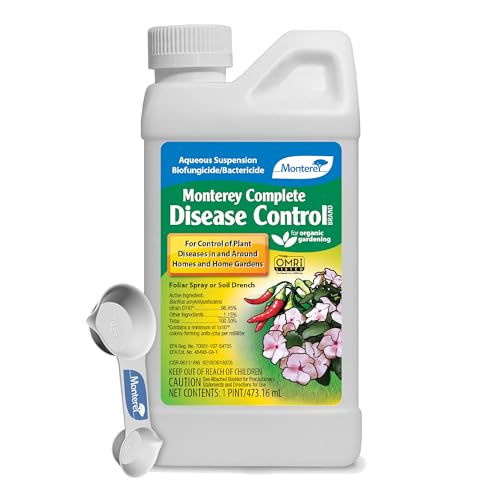
Best for: home gardeners seeking broad disease prevention and root protection. It helps control powdery mildew, rust, leaf blight, brown rot, and more, while colonizing root hairs to reduce disease establishment.
Why chosen: Its root-zone action adds a proactive layer of defense, which can be particularly useful for transplants or plants with a history of soil-borne diseases.
Limitation: It requires careful mixing and labeling to ensure correct dilution and application timing for different plant types. Follow label instructions precisely to avoid phytotoxicity on sensitive species.
NATRIA Disease & Fungus Control

Best for: gardeners seeking a ready-to-use, copper-containing option for powdery mildew and other listed diseases. Suitable for homes, gardens, and greenhouses, including organic setups.
Why chosen: This product covers a wide disease spectrum, including powdery mildew, rust, black spot, and more, with a ready-to-use format that suits immediate disease concerns.
Limitation: Copper-based products can accumulate in the soil and may burn tender growth if misapplied. Avoid excessive or repeated use on sensitive ornamentals.
Grower’s Ally Fungicide

Best for: organic gardeners who want a copper-free option that remains harvest-friendly. It targets powdery mildew, mold, and fungal diseases on vegetables, ornamentals, and houseplants.
Why chosen: The citric acid-based formula provides fungal control without heavy metals or synthetic pesticides. It’s gentle on new growth and safe for edible crops when used as directed.
Limitation: As a non-copper alternative, it may require more frequent applications during humid or rainy periods to maintain protection.
Neudorff Copper Fungicide

Best for: growers who prefer traditional copper-based protection for a broad disease range in both indoor and outdoor settings. Suitable for fruit trees, roses, vegetables, and ornamentals.
Why chosen: Copper fungicides are a long-standing standard for disease prevention and control, offering reliable protection for a wide range of listed diseases.
Limitation: Copper can stain surfaces and may accumulate in soil with repeated use. Use as directed and rotate with non-copper products to minimize buildup and potential phytotoxicity.
Buying Guide: Key Purchase Considerations
What type of disease am I targeting? Choose copper-based products for broad disease control and exterior crops, or copper-free formulas for pesticide-sensitivity plants or edible crops near harvest day.
Indoor vs. outdoor use: Indoor plants may benefit from copper-free or essential-oil blends to minimize residue and odors. Outdoor gardens can tolerate more robust formulations but require environmental considerations like rainfall and drainage.
Application method: Sprays are versatile for foliage and fruit, while drenches reach root systems. Some products also act as soil amendments for root health; follow label directions for correct use.
Organic compatibility: Look for OMRI-listed options if organic certification is important. Copper-free formulas may also be favored by organic growers seeking low-residue solutions.
Plant sensitivity: Some plants are more susceptible to copper burn or phytotoxicity. Test on a small patch before broad application, especially with tender or newly transplanted specimens.
Reapplication frequency: Humidity, rainfall, and plant growth stage affect how often you should reapply. Dry environments may require less frequent treatments, while wet periods may demand more frequent protection.
FAQ
- What is the difference between a fungicide and a bactericide for plants? A fungicide protects against fungal diseases, while a bactericide targets bacterial diseases. Some products provide broad-spectrum coverage for both pathogens depending on formulation.
- Can I use copper-based fungicides on edible crops? Yes, many copper-based fungicides are permitted for organic gardening and can be used on edible crops, but follow label directions and harvest timelines to ensure safety.
- Are copper-free fungicides as effective as copper-based ones? Copper-free options, such as citric-acid-based formulations, can be effective for many diseases but may require more frequent applications and may not cover all copper-sensitive pathogens.
- Should I rotate products to prevent resistance? Rotating products with different active ingredients and mechanisms can help manage disease pressure and reduce resistance risk.
- Is it safe to use these products around pets and kids? Most products are formulated to be safe when used as directed, but avoid spraying while children or pets are in the area and allow full drying before reentry.
- Do these products work indoors? Many are suitable for indoor use on houseplants, particularly copper-free or essential-oil blends to minimize residue and odors.