Find the right bug spray for trees to protect your landscape. This guide highlights five effective options for outdoor use, covering insect prevention, disease control, and safe, practical application. Best for homeowners with trees and shrubs seeking long-lasting protection, fast results, or organic-friendly solutions.
| Product | Best For | Key Benefit |
|---|---|---|
| BioAdvanced Tree & Shrub Insect Killer (32 oz) | All-around tree and shrub protection | Fast knockdown and up to 2 weeks of control |
| BioAdvanced 3-in-1 Insect, Disease, and Plant Mite Control (32 oz) | Combines insect, disease, and mite control | Broad-spectrum protection, 30 days expected coverage |
| Bonide Captain Jack’s Neem Oil (32 oz) | Organic-friendly, multi-purpose | Kills insects in all life stages; fungicidal action |
| BioAdvanced 3-in-1 Insect, Disease, and Plant Mite Control Spray (24 oz) | Smaller volume option with 14 days protection | Three-in-one formula for pests, diseases, and mites |
| Bonide Annual Tree & Shrub Insect Control with Systemaxx (128 oz concentrate) | Long-term root-system protection | Move-through root zone for extended protection |
BioAdvanced Tree & Shrub Insect Killer, 32 oz

Best for: Homeowners seeking quick, visible suppression of listed insects on trees and shrubs. This ready-to-spray formula provides rapid contact kill and a two-week residual effect, helping protect new growth and ornamental plantings. Selection rationale: simple application without mixing, making it suitable for routine lawn and garden care.
Caution: Should be applied when there is no active pollinator activity in the immediate area to avoid unintended exposure.
BioAdvanced 3-in-1 Insect, Disease, and Plant Mite Control (32 oz)
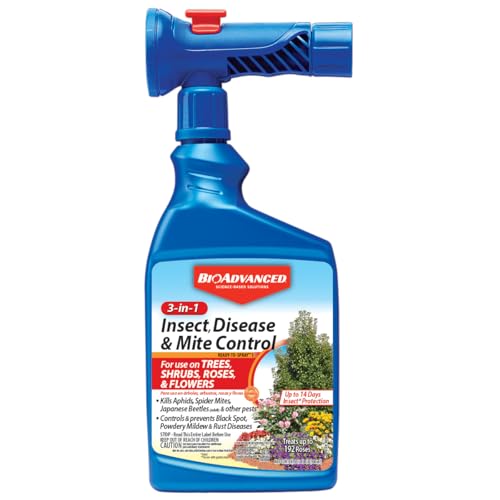
Best for: Gardeners needing all-in-one protection against pests, plant diseases, and mites on roses, flowers, shrubs, and trees. Selection rationale: one product covers multiple threats, reducing the need for separate treatments. Limitations: may require reapplication every few weeks depending on weather and pest pressure.
Bonide Captain Jack’s Neem Oil, 32 oz
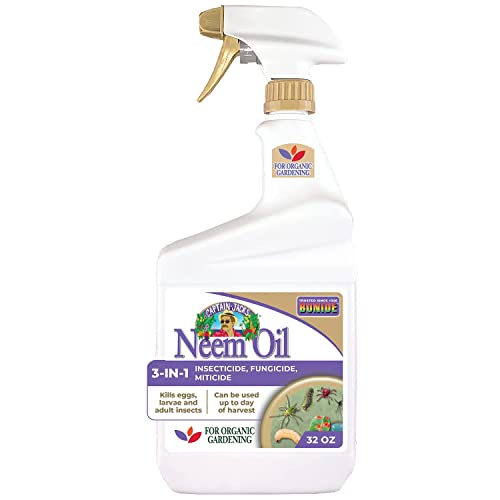
Best for: Gardeners preferring organic or semi-organic pest control with fungicidal properties. Selection rationale: neem oil works on contact and as a preventative, with broad-spectrum impact against mites, aphids, and powdery mildew. Caution: efficacy can vary with temperature; do not apply during extreme heat.
BioAdvanced 3-in-1 Insect, Disease, and Plant Mite Control Spray (24 oz)

Best for: Users who want a ready-to-use spray with extended protection up to 14 days on a smaller bottle. Selection rationale: combines insect, disease, and mite control in one application, suitable for smaller spaces or container plantings. Limitation: shorter protection window than larger-volume options.
Bonide Annual Tree & Shrub Insect Control with Systemaxx (128 oz)

Best for: Landscapers and homeowners seeking long-term insect protection that moves through the root zone for systemic coverage. Selection rationale: Systemaxx helps protect from within the tree or shrub, potentially extending protection to new growth. Limitation: concentrates require mixing, and effectiveness depends on proper soil uptake.
Buying Guide
What should you consider when choosing a tree bug spray?
- Target pests: Identify common pests in your area (aphids, beetles, mites, scale) and pick a product formulated to address them.
- Coverage and duration: Larger containers may provide longer protection but require more frequent applications in hot weather. Consider your local climate and tree size.
- Direct vs. systemic action: Contact insecticides kill on contact, while systemic products move through the plant. Systemic options can provide longer protection for woody plants.
- Safety and suitability: For organic gardening, Neem Oil or other organic-friendly formulas are preferred. Always follow label directions for safe usage near beneficial insects and pollinators.
- Application method: Ready-to-spray options are convenient for quick patches, while concentrates may be more economical for large landscapes but require mixing.
- Plant compatibility: Some products are labeled for use on roses, ornamentals, and fruit trees; ensure your target plants are listed on the label.
How to apply bug sprays to trees safely
- Apply during calm, dry conditions to minimize drift and maximize effectiveness.
- Avoid spraying blooms when pollinators are active; opt for early morning or late evening applications where permitted.
- Test a small area first to check for phytotoxicity on sensitive plants.
- Water trees after application if the label requires it, to aid absorption in systemic products.
Frequently asked questions
- Q: Can I use these sprays on edible fruit trees? A: Only if the label explicitly permits use on fruit trees and lists the fruits you grow.
- Q: How soon will I see results after application? A: Contact-kill products often show rapid effects; some products list protective windows up to 14–30 days depending on formula and weather.
- Q: Are these safe for pollinators? A: Use the products according to label directions and avoid flowering periods when pollinators are active whenever possible.
- Q: Can I mix multiple products? A: Do not mix unless the label explicitly says it is safe to combine products. Overlapping actives can damage plants or reduce effectiveness.
- Q: Is systemic protection more effective for trees? A: Systemic products can move within the plant to protect new growth, which can be advantageous for larger trees with extensive canopies.
- Q: How should I store these products? A: Store in a cool, dry place away from children and pets, and keep tightly sealed when not in use.