Answering the right buyer intent: these CO2 meters help growers monitor air quality to optimize plant health and environmental conditions. They are best for grow rooms, tents, and home gardens where precise CO2, temperature, and humidity readings matter. This guide highlights five reliable options and explains who each is best for, with a practical buying guide and a quick FAQ.
Summary table of selected products:
| Product | Best For | Key Reason |
|---|---|---|
| Temtop CO2 Monitor | Small to medium grow rooms | NDIR sensor, high accuracy, long standby |
| Dienmern 5-in-1 | Versatile monitoring on the go | Swiss sensor, real-time CO2 with long battery life |
| Lwyinp 5-in-1 | Clear data visualization | Color display, multi-gas sensing |
| GoveeLife Smart Monitor | Smart home integration | App readings, alarms, multiple metrics |
| INKBIRDPLUS PTH-10C | Portable, budget-friendly | NDIR sensor, alert customization |
Temtop CO2 Monitor Indoor Air Quality Monitor

Best for compact grow rooms that need precise CO2 readings alongside temperature and humidity. This device measures CO2 from 400 to 5000 ppm and offers a Swiss-engineered NDIR sensor for accuracy. Its 1 ppm resolution and 5-second refresh help track rapid CO2 changes relevant to plant cycles. It also supports a long standby time, making it suitable for steady monitoring during extended grow cycles.
Who it’s best for: small to medium grow spaces where consistent, real‑time air data is essential for CO2 management and plant health. Why selected: high accuracy in the critical range and quick updates support proactive ventilation decisions. Caution: ensure proper placement away from heat sources to avoid skewed readings.
Dienmern 5-in-1 CO2 Detector

Best for flexible monitoring where real-time CO2, temperature, humidity, and AQI data are needed. This device uses a Swiss-made CO2 sensor with a broad 400–5000 ppm range and ±50 ppm accuracy. It includes a built-in 1600mAh battery, enabling up to 72 hours of portable use, which suits grow tents or temporary setups where power access is limited.
Who it’s best for: growers who want a portable solution that can move between tents or rooms. Why selected: strong accuracy and long battery life reduce the need to run dedicated power for short-term monitoring. Caution: battery life varies with display usage and alarm settings.
5-in-1 Indoor Air Quality Monitor (CoillBlow)

Best for homes and grow spaces seeking a clear color display with simple air-quality interpretation. It detects CO2, HCHO (formaldehyde), TVOC, temperature, and humidity in real time. The LCD screen provides quick readings, and the device includes an air quality level indicator to help you act when levels exceed safe ranges.
Who it’s best for: growers who want a single, easy-to-read device to watch multiple pollutants at once. Why selected: straightforward display and proactive indicators support rapid ventilation decisions. Caution: the device may require calibration for optimal accuracy in unique environments.
Air Quality Monitor Indoor, Lwyinp 5-in-1

Best for home offices, classrooms, and grow tents that require a visually rich data presentation. This monitor combines real-time CO2, HCHO, TVOC, temperature, and humidity with a 3-color visualization system on a high-definition color screen. It emphasizes data visualization to help identify trends quickly.
Who it’s best for: users who benefit from quick color cues and a broader gas detection suite. Why selected: the 3-color system makes it easier to interpret risk at a glance. Caution: sensor drift can occur; periodic checks help maintain accuracy.
GoveeLife Smart Air Quality Monitor

Best for smart-home setups that want ongoing alerts and app-based control. This monitor uses a photoacoustic NDIR CO2 sensor with a ±40 ppm + 5% accuracy and a 5-second refresh. It shows real-time CO2, temperature, humidity, and a clock when connected to the app, plus a triple alert system via sound, app notifications, and emails.
Who it’s best for: households or grow rooms integrating with broader smart ecosystems. Why selected: fast updates and multi-channel alerts help maintain ventilation without constant manual checks. Caution: appliance calibration may be needed to maintain peak accuracy over time.
U UNNI CO2 Monitor for Home
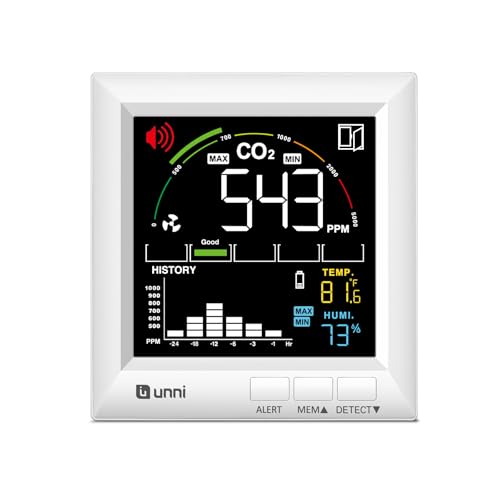
Best for budget-minded growers who still want reliable CO2, temperature, and humidity data. The device uses a Swiss-made photoacoustic sensor and provides readings in a 400–5000 ppm range with accuracy around ±5% + 50 ppm. It includes multiple alarm options and a capably wide operating range for home environments.
Who it’s best for: growers seeking a balance of price and performance with dependable data. Why selected: strong sensor technology at a lower price point. Caution: ensure adequate ventilation around the unit to prevent local readings from skewing the feel of the room.
Buying Guide: How to Choose a Grow Room CO2 Meter
- Sensor technology: Prefer NDIR sensors for CO2 accuracy in the 400–2500 ppm range, which is critical for plant growth stages.
- Display and data: Look for clear readouts, color-coded visuals, and data logging capabilities to track trends over time.
- Multi-parameter sensing: CO2 plus temperature and humidity are essential. Some models also detect HCHO and TVOC for broader air quality awareness.
- Power and portability: Choose between plug-in models for constant use and battery-powered or rechargeable units for movable setups or tents.
- Alarms and alerts: Decide if you need audible alarms, app notifications, email reports, or all three for timely ventilation actions.
- Size and placement: For grow rooms, place the monitor away from direct airflow sources to avoid skewed readings, and ensure the device can capture representative air.
- Durability and calibration: Regular calibration improves accuracy. Some devices offer easier calibration workflows via apps or user menus.
FAQ
- What CO2 level is best for a grow room?
Ideal CO2 levels vary by plant type, but many growers target a range around 800–1500 ppm during active growth, adjusting ventilation based on plant needs and stage.
- Do I need a separate CO2 monitor for each grow tent?
Not necessarily. A single well-placed monitor can suffice for a small room, but multiple tents may require individual readings to account for air flow differences.
- What’s the advantage of a 5-in-1 monitor?
A 5-in-1 monitor provides CO2, temperature, humidity, and sometimes HCHO and TVOC, offering a broader view of indoor air quality that helps optimize conditions for plant health and human comfort.
- How often should I calibrate CO2 sensors?
Calibration frequency depends on usage and environment. Regular checks, particularly after moving the device or changing location, help maintain accuracy.
- Is a higher price worth it for CO2 monitoring?
Not always. Compare sensor type, reading stability, and data presentation. Higher-priced models often offer better accuracy, longer battery life, and smarter alerts.
- Can these monitors operate in grow tents?
Yes. Many models are designed for indoor environments and portable enough to place in grow tents while avoiding direct airflow sources that could skew results.