Answering the common search for a reliable dethatcher attachment for tractors, this guide highlights five sturdy options suitable for large lawns and gardens. Each choice is explained for who it’s best for, why it’s a strong pick, and a quick caution to consider before buying. Ideal buyers include homeowners with expansive yards, landowners managing thick thatch, and those who want easier, faster dethatching behind a riding mower or tractor. The table below summarizes the five selected products for quick comparison.
- AugFir 48-Inch Tow Behind Dethatcher
- BlumeTrec Tow Behind Dethatcher
- Agri-Fab 40in Tow Behind Lawn Dethatcher
- Suchtale 40inch Tow Behind Dethatcher
- LAKEROD 40″ Tow Behind Lawn Dethatcher
| Product | Working Width | Notable Feature | Best For |
|---|---|---|---|
| AugFir 48-Inch Tow Behind | 48 in | Heavy ballast tray for deeper penetration | Large yards, frequent dethatching |
| BlumeTrec Tow Behind | 40 in | 20 replaceable tines, quick assembly | Wide-area coverage, easy setup |
| Agri-Fab 40in Tow Behind | 40 in | USA-made, 20 durable tines | Traditional, dependable dethatching |
| Suchtale 40inch Tow Behind | 40 in | 70 lb ballast platform for deeper bite | Rugged lawns and large yards |
| LAKEROD 40″ Tow Behind | 40 in | Up to 70 lb ballast, moss and thatch uplift | Medium to large lawns, easy towing |
AugFir 48-Inch Tow Behind Dethatcher

Best for large properties, the AugFir dethatcher features a wide 48-inch working width with two rows of independently flexing tines. A heavy 150 lb ballast tray enhances tine penetration, improving thatch removal efficiency. The adjustable hitch height helps accommodate uneven terrain, and an anti-slip stopper keeps settings secure during turns. Use this when tackling thick thatch across expansive lawns where time savings matter. Caution: Clean soil from tines after use to preserve effectiveness.
BlumeTrec Tow Behind Dethatcher

Best for large lawns, the BlumeTrec dethatcher uses 20 heavy-duty, heat-treated spring tines on a 40-inch wide frame. The universal pin-style hitch allows easy attachment to riding mowers, tractors, ATVs, or UTVs. Its wheel bearings improve load handling, supporting efficient dethatching in fewer passes. Consider this option if you want straightforward setup and strong thatch removal with replaceable tines. Caution: Avoid reversing while operating to prevent tine damage.
Agri-Fab 45-0294 40in Tow Behind Dethatcher
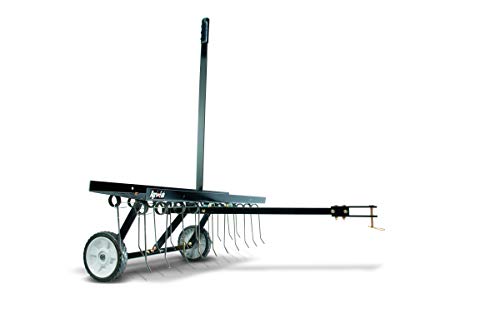
Better for traditional, dependable dethatching, the Agri-Fab 40-inch model uses 20 durable spring tines to uproot thatch and loosen compacted soil over a 40-inch swath. It’s made in the USA and designed for easy towing behind lawn and garden tractors. Choose this if you want a straightforward, proven design with broad compatibility for standard riding mowers. Caution: Typical maintenance includes cleaning and inspecting tines for wear.
Suchtale 40inch Tow Behind Dethatcher

Best for medium to large lawns, the Suchtale 40-inch dethatcher comes with 20 heat-treated, rust-resistant spring tines and a 70 lb ballast platform for deeper penetration. The design includes a transport handle for easier tine raising and lowering, and a wheel-bearing supported frame to reduce drag. Choose this if you need good balance between ballast and maneuverability. Caution: Regularly check ballast distribution to maintain even depth across the span.
LAKEROD 40″ Tow Behind Lawn Dethatcher

Best for mid-to-large lawns requiring consistent dethatching, the LAKEROD model uses 20 heat-treated, spring tines and an optional ballast tray up to 70 lbs. Its construction emphasizes a steady dethatching process with reinforced tray edges and smooth rubber-treated wheels for gentle grass contact. It’s suitable for lawns with patches of moss or thatch needing deeper penetration. Caution: Ensure ballast is evenly distributed to avoid uneven tines depth.
Buying Guide
Key purchase considerations for a dethatcher attachment:
- Working width: Wider implements cover more ground but may be harder to maneuver on tight spaces. Choose 40–48 inches for large lawns, 40 inches for mid-size properties.
- Tine construction: Spring steel tines lift and loosen thatch effectively. Look for replaceable tines to extend tool life and confirm rust resistance.
- Ballast tray: A ballast tray adds weight for deeper dethatching. Check load capacity (e.g., 70–150 lb) and ensure it’s easy to load and distribute evenly.
- Hitch compatibility: Ensure the attachment fits your tractor or mower’s hitch (universal pin-style hitches are common). Verify height adjustability for different terrain.
- Durability and wheels: Steel frames with bearing-supported wheels provide stability. Rubber-treated wheels protect healthy grass on uneven ground.
- Usage timing: Late summer to fall is often ideal for dethatching to prepare soil for overseeding or root growth.
- Safety: Avoid reversing or abrupt turns with tines engaged; follow manufacturer guidelines for attachment and operation.
Frequently Asked Questions
- What’s the main benefit of a 48-inch dethatcher?
It reduces the number of passes needed on large lawns, saving time and effort. - Are replaceable tines worth it?
Yes, replaceable tines extend the tool’s life and maintain effective dethatching performance. - Can I use a dethatcher on all grass types?
Most are suitable for common lawns, but avoid heavy dethatching on newly seeded or very fragile turf. - Is ballast necessary?
Ballast increases tine penetration for deeper thatch removal but must be balanced to avoid mower instability. - Do these attach to tractors or only riding mowers?
Most listed models use a universal hitch and attach to riding mowers, tractors, ATVs, or UTVs, depending on the hitch system. - When is the best time to dethatch?
Fall is typically ideal for thatch removal to improve air, water, and nutrient penetration before winter and spring growth.