Answering the question for small-farm water stewardship, these drip irrigation kits offer precise, low-pressure watering with easy setup. They’re best for farmers seeking straightforward installation, scalable systems, and reliable moisture delivery across multiple rows. The top picks below prioritize mainline durability, expandable options, and user-friendly controls for different farm sizes and layouts. This guide helps you compare kits by suitability, expansion potential, and installation considerations.
| Product | Best For | Key Benefit |
|---|---|---|
| Drip Irrigation Kit for Small Farms – Deluxe | Small to mid-size plots with multiple rows | Comprehensive kit with durable mainline and perma-loc row valves |
| Drip Depot Drip Irrigation Kit for Small Farms – Standard | Budget-conscious setups with easy setup | Longer runs and straightforward 5/8″ drip tape |
| Drip Irrigation Kit for Small Farms – Premium | Expanded systems and timer compatibility | Timer and rain barrel compatibility for automation |
| Tondiamo 1000 ft Drip Tape Kit | Larger fields with 6″ spacing | 500–1000 ft runs, 6″ spacing, durable components |
| Maasechs 1000 ft Drip Tape Kit | Long-term, high-coverage irrigation | Extended length, 7.87″ spacing, color-coded fittings |
Drip Irrigation Kit for Small Farms – Deluxe
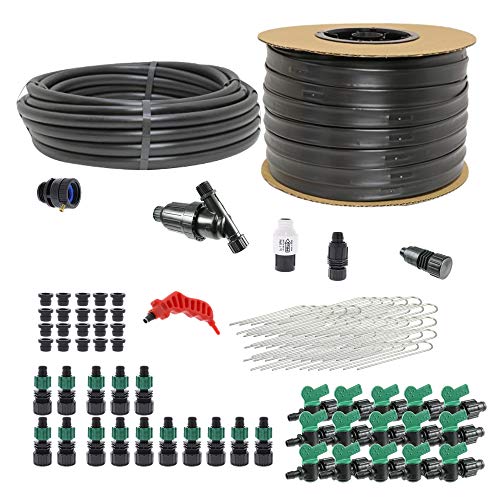
The Deluxe kit is designed for small farms requiring a complete, ready-to-install system. It includes a mainline 3/4″ poly tubing and individual Perma-Loc valves to control each drip tape row. This configuration supports higher flow rates and longer tape runs, making it well-suited for multi-row plots with varying watering needs. Best for growers who want a turnkey setup with centralized control over each row, reducing manual adjustments.
Best for: Farms with several crop rows and a need for reliable, sectioned irrigation. Choose this if you want a robust mainline and easy per-row isolation.
Caution: Verify space for mainline layout and ensure your water source can sustain the higher flow requirements of longer runs. Over-pressurization could affect connections if not managed with proper regulators.
Drip Depot Drip Irrigation Kit for Small Farms – Standard

The Standard kit emphasizes a 3/4″ mainline with 5/8″ drip tape, optimized for straight-row gardens and small farms that want predictable, uniform moisture delivery. It includes straightforward setup instructions online, making it accessible for newer installers while still meeting practical irrigation needs. Best for: farms prioritizing simplicity and dependable coverage across evenly spaced rows.
Best for: First-time drip installers or farms with uniform row spacing. Avoid this if you need extensive automation or a high-capacity mainline beyond typical small-farm demands.
Drip Irrigation Kit for Small Farms – Premium
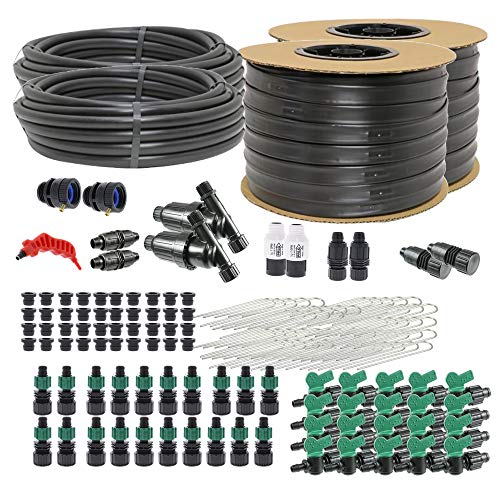
The Premium kit adds expandability and compatibility with timers and rain barrels. It’s designed for growers who anticipate growing their system over time and want to automate watering while maintaining a moderate flow range (10-15 PSI). Best for: Farms seeking automation readiness and future expansion without reconfiguring the entire system.
Best for: Those planning to automate irrigation or connect to rainwater storage. Caution: Ensure your water source can sustain 10–15 PSI without fluctuations that could impact uniform delivery.
Tondiamo 1000 ft 5/8 Inch Drip Tape Kit

This kit provides a long 1000 ft 5/8″ mainline with 6″ drip tape spacing, plus a bundle of accessories for a complete install. The blue and black fittings aid in component identification, and the system is described as robust against sun exposure with a 30 PSI operating tolerance. Best for: Larger small-farm plots or perennial beds needing uniform, broad coverage. Choose this if you’re planning long rows with consistent emitter spacing.
Limitation: Household water pressure should be moderated with a pressure limiter to avoid over-pressurization at the line joints.
Tondiamo 1000 ft 5/8 Inch Drip Tape Kit 16 Mil

The 1000 ft kit from Tondiamo mirrors the 500 ft and expands to cover larger areas with 6″ spacing, 16 mil tubing, and included accessories for easy installation. It uses durable PE tubing and color-coded fittings to improve installation efficiency. Best for: Farmers needing extended runs and a reliable, long-term irrigation solution with uniform head-to-head coverage.
Best for: Expansive small-farm layouts or gardens requiring consistent moisture across many beds. Caution: As with other high-volume kits, ensure the supply includes adequate filtration to protect emitters from clogging.
Drip Irrigation System 230FT – Abakuku

The Abakuku kit focuses on quick-connect practicality, featuring 1/4″ and 1/2″ tubing with a plug-and-play approach. It includes a variety of emitters and fittings to support different plant types, making it suitable for mixed crops in raised beds and greenhouses. Best for: Garden beds that require rapid setup and flexible emitter options. Choose this if you want easy connections without specialized tools or heavy setup time.
Limitation: This kit emphasizes versatility over volume; for large fields with extensive plantings, a larger mainline option may be more efficient.
Maasechs 1000 ft Drip Tape Kit

The Maasechs kit offers a complete irrigation package with 1000 ft of 5/8″ tubing and 7.87″ emitter spacing. It includes a large set of accessories like end plugs, couplers, tees, elbows, and bypass valves. It is designed for UV resistance and ease of installation with color-coded fittings for quick assembly. Best for: Long-term projects that require consistent head-to-head coverage and easy component differentiation. Choose this if you want a scalable setup with clear identification of components.
Limitation: The longer length and more parts can require careful planning during installation to avoid misplacing fittings or creating leaks at joint connections.
Buying Guide
Key considerations when selecting a drip irrigation kit for a small farm:
- Mainline size and flow: 3/4″ mainlines support longer runs and more emitters; smaller mains save cost but may limit coverage.
- Emitter spacing: 6″ vs 8″ or more affects uniformity and water usage. Determine crop density and root zones to match spacing.
- Automation readiness: If you plan timer integration or rain barrel compatibility, choose Premium-level kits with expansion options.
- Durability and UV resistance: PE tubing and color-coded fittings help with longevity and installation clarity in sun-exposed areas.
- Adaptability: Look for kits with add-on options (additional rows, more emitters, quick-connect upgrades) to scale over time.
- Pressure management: Confirm operating pressure ranges and whether a limiter or regulator is needed to prevent leaks or misflow.
- Installation complexity: Beginner-friendly kits save time, whereas more expandable systems require careful layout planning.
FAQs
- What length of drip tape should I choose for a small farm?
– Choose based on your row length and desired spacing; longer rows require longer tape with compatible mainlines. - Do these kits require a pump or can they run on existing water pressure?
– Most kits are designed for low to moderate pressure; some may require pressure regulation for optimal performance. - Is automation essential for drip irrigation on small farms?
– Not essential, but it improves consistency and saves labor; Premium kits are designed with automation in mind. - Can I expand a standard kit later?
– Yes, many kits offer expansion options like additional rows, emitters, or a larger mainline. - Will these kits work in shaded or greenhouse environments?
– Yes, most kits are adaptable, but you may need micro-emitter adjustments for different light exposure and plant types. - What maintenance should I perform regularly?
– Check emitters for clogging, inspect joints for leaks, and flush lines periodically to prevent buildup.