Answering the common buyer question: the best fertilizer for clover food plots is a product that supports rapid green-up, strong regrowth, and soil health without burning plants. This guide highlights options designed for white, red, or ladino clover, plus a few complementary plot enhancers. Each pick targets clover growth, with notes on who benefits most and practical limits to consider. Ideal users include wildlife plot managers, rural homeowners with deer-friendly plots, and anyone seeking dependable clover performance through season-long forage.
| Product | Best For | Why It Stands Out |
|---|---|---|
| CloverMAXX Liquid Clover Fertilizer | Active plots needing fast green-up | Micronized nutrients for rapid growth; easy liquid application; covers up to 1 acre |
| Antler King Clover Fuel | Speeding up legume growth | Legume-specific formula to enhance clover, soybeans, alfalfa; thicker, faster plots |
| Clover Fertilizer (TPS NUTRIENTS) 1 Gallon | Medium-to-large lawns and meadows | Supports green coverage and soil health; versatile for clover lawns and ground cover |
| Clover Fertilizer (TPS NUTRIENTS) 32oz | Smaller applications or spot treatments | Similar benefits in a smaller package; easy handling |
| Big Tine Food Plot Mix | Whole plot establishment with clover alongside other forage | Perennial mix with high drought tolerance; fast establishment |
CloverMAXX Liquid Clover Fertilizer for Food Plots
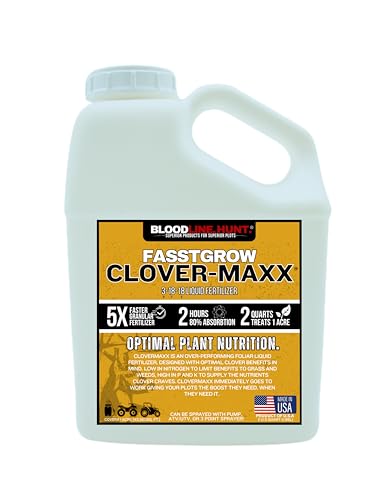
Best for: rapid green-up on established clover plots. The micronized nutrient package supports quick regrowth after grazing or mowing, making it suitable for high-traffic plots where deer visitation is frequent. The liquid format mixes easily with water and works with backpack or ATV sprayers, reducing effort on larger plots. Caution: avoid applying during extreme heat to prevent leaf burn and ensure thorough coverage.
Antler King Clover Fuel Food Plot Enhancer

Best for: speeding growth in legume-based plots. Clover Fuel is designed to boost clover performance alongside other legumes like soybeans and alfalfa, helping plots become thicker and more resilient. It is formulated to be non-burning when applied as directed. Limitation: the product targets legume-specific response, so non-legume forages may see limited benefits.
Clover Fertilizer — Liquid Fertilizer For Clover Lawns (1 Gallon)

Best for: boosting green coverage in clover lawns or microclover patches. This liquid formulation supports dense, vibrant clover growth and promotes soil vitality, making it a solid choice for ground covers and mixed lawn systems. Caution: designed for lawns and similar applications; for large-scale food plots, consider a larger-volume product or compatible mixer.
Clover Fertilizer — Liquid Fertilizer For Clover Lawns (32oz)

Best for: smaller plots or patch applications needing quick, even coverage. The 32-ounce size mirrors the 1-gallon option in formulation, offering the same benefits for green growth and soil health with a more compact volume. Limitation: coverage per application is smaller, so plan for multiple applications on larger plots.
Pennington Rackmaster Durana White Clover Seeds

Best for: establishing enduring clover ground cover in food plots. While primarily a seed, Durana clover is a popular choice for deer plots due to persistence under grazing pressure. It complements fertilizer programs by providing a robust base that responds well to nutrient inputs. Caution: seed establishment may require proper soil preparation and moisture for best results.
Big Tine Food Plot Mix

Best for: establishing a diverse deer forage including clover alongside other perennials. This premium mix supports quick plot establishment and drought tolerance, making it a versatile foundation for wildlife plots. Limitation: mix may require precise overview of soil health and watering during establishment to achieve optimal results.
Buying Guide: Key Considerations For Clover Food Plots
- Plot size and application method: Liquid fertilizers are easier to apply on large plots, while smaller bottles suit spot treatments or lawn-scale plots.
- Soil health and existing forage: If soil tests show nutrient deficiencies, start with a balanced N-P-K approach and follow with clover-specific products for green-up.
- Clover variety compatibility: Red, white, ladino, and microclover each respond differently to nutrients; select products designed for legumes to maximize uptake.
- Watering and weather: Apply during moderate temperatures and avoid application just before heavy rain to prevent runoff or nutrient burn.
- Longevity and establishment: Perennial mixes and seed-forward programs require timing alignment with planting windows and seasonal rainfall.
- Safety and compatibility: Check label directions for crop safety when applying near grasses or other forage plots to avoid unintended burn.
Frequently Asked Questions
- What fertilizer is best for clover food plots?
– A fertilizer or planter specifically formulated for legumes and clover, paired with soil health practices, tends to yield faster green-up and stronger regrowth. - Can I mix liquid fertilizer with water for easier application?
– Yes, many liquid products are designed to mix with water and can be applied with common sprayers, offering convenient coverage for larger plots. - Should I apply fertilizer before or after planting clover seeds?
– For established plots, apply as recommended to support regrowth; for newly planted seed, follow seed-specific guidance and adjust based on soil test results. - Will fertilizer burn clover?
– When used as directed and not over-applied, most clover-focused products are formulated to minimize burn; avoid high-rate applications in heat or drought conditions. - Is a seed mix better than fertilizer alone for deer plots?
– A balanced approach often works best: use a durable seed mix like a clover blend with a compatible fertilizer to support soil health and sustained forage. - How do I choose between gallon and smaller liquid sizes?
– Choose based on plot size and frequency of application; larger plots may benefit from the gallon-size options to reduce refill frequency.