Answering the need for an easy, targeted tree nutrition method, fertilizer spikes provide slow-release nutrients directly to root zones. They’re best for homeowners seeking simple, mess-free feeding for deciduous, flowering, evergreen trees and acid-loving plants. The top options below are chosen for reliability, ease of use, and clear benefits across a range of trees such as hydrangeas, maples, oaks, and citrus. Use this guide to compare which spike system fits your landscape and seasonal feeding plan.
| Product | Best For | NPK Style | Quantity |
|---|---|---|---|
| Deciduous & evergreen trees, acid-loving plants | 8-5-6 | 12 spikes | |
| Jobe’s Tree Fertilizer Spikes 16-4-4 | All shrubs & trees, low-maintenance feeding | 16-4-4 | 15 spikes |
| Jobe’s Slow Release Tree & Shrub Spikes (9 Count) | Varied trees & shrubs, acid-loving varieties | 15-3-3 | 9 spikes |
| The Old Farmer’s Almanac Tree & Shrub Spikes | Season-long nutrition for mixed landscapes | 5 Inch TruSpikes, unspecified NPK | 24 spikes |
| Miracle-Gro Fruit & Citrus Spikes | Citrus, fruit trees, palms | 10-15-15 | 12 spikes |
Miracle-Gro Tree and Shrub Spikes

Best for: Homeowners feeding deciduous, flowering, evergreen trees and acid-loving plants such as hydrangeas and azaleas. These spikes deliver slow-release nutrients directly to root zones, helping promote vibrant color and foliage. They are easy to apply and reduce the risk of runoff compared with surface feeding. Caution: avoid inserting spikes too close to the trunk to prevent root damage.
Jobe’s Tree Fertilizer Spikes 16-4-4

Best for: All deciduous trees and shrubs seeking a steady nutrient supply with minimal waste. The 16-4-4 formula supports continuous feed beneath the surface where active roots grow. Limitation: heavier application mass might be less convenient for small yards or container trees.
Jobe’s Slow Release Tree & Shrub Spikes (9 Count)

Best for: Oak, maple, dogwood and other acid-loving trees and shrubs needing a long-lasting nutrient supply. The 15-3-3 NPK supports ongoing growth below the surface. Choose this if you want twice-yearly feeding with predictable intervals. Caution: ensure proper spacing around the root zone to avoid trunk contact.
The Old Farmer’s Almanac Tree & Shrub Spikes

Best for: Established landscapes needing fast-acting nutrition that lasts through the season. The TruSpikes are easy to hammer in and designed for durable use without cap breaking or shattering. Best results come with a seasonal feeding plan—early spring and late fall. Limitation: not all users may require the full 24-spike case for small yards.
Miracle-Gro Fruit & Citrus Spikes
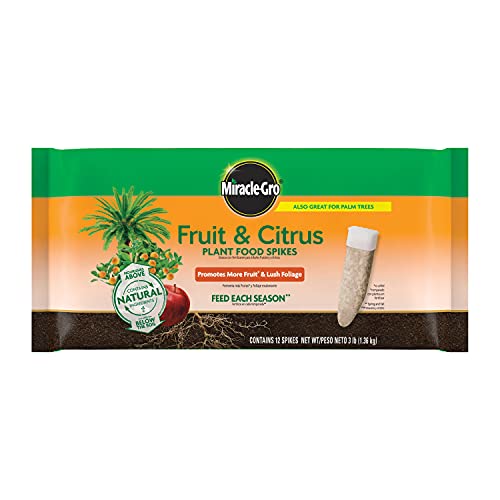
Best for: Citrus and fruit trees, including apples, oranges, lemons, limes, avocados, and even some palms. This formula targets fruit production and foliage, supporting a robust harvest. Apply twice a year—early spring and mid-fall—for continuous nourishment. Caution: avoid over-fertilizing sensitive citrus varieties; follow spacing guidelines for root zones.
Buying Guide
What should I look for in fertilizer spikes?
Key factors include NPK ratios, suitability for tree type (deciduous, evergreen, or acid-loving), and application frequency. Spikes with balanced or fruit-focused formulas suit fruit trees, while those with lower nitrogen can suit slow, steady growth for ornamentals.
How many spikes do I need?
Consider tree size and root spread. Larger trees require more spikes spread evenly around the drip line, whereas smaller trees need fewer units. Concentrate on products offering 12–24 spikes for typical yard trees, or bulk options for larger landscapes.
Are spikes better than granular fertilizers?
Fertilizer spikes reduce surface runoff and provide nutrients directly to the root zone. They’re generally cleaner and easier to apply than granular mixes, but may be slower to react than some quick-release options. Choose spikes for ease and predictable seasonal feeding.
What about acidity and plant types?
Acid-loving plants (azaleas, hydrangeas, magnolias) respond well to specialized formulas with nutrients delivered at their preferred pH. Citrus and fruit trees benefit from spikes labeled for fruit or citrus, which emphasize higher phosphorus and potassium for fruiting.
Safety and usage tips
- Read label directions carefully and space spikes around the drip line, not directly at the trunk.
- Avoid saturating soil with spikes in isolated pockets; distribute evenly.
- Water after applying to help nutrients reach the roots.
- Keep fertilizers away from children and pets when applying.
FAQ
- Q: How often should I apply tree fertilizer spikes? A: Most products suggest twice yearly feeding—early spring and late fall—though some fruit-focused spikes may have different schedules.
- Q: Can spikes cause root burn? A: When used as directed, the risk is low. Avoid placing spikes directly against the trunk and follow spacing guidelines.
- Q: Are there spikes for acid-loving plants? A: Yes. Several options are suitable for hydrangeas and magnolias, offering targeted nutrition for acidic soils.
- Q: Do spikes work for evergreen trees? A: Yes. Many spikes are formulated to support evergreen roots and overall foliage health.
- Q: Should I water immediately after applying spikes? A: Yes, watering helps nutrients reach the root zone and reduces the chance of surface runoff.
- Q: Is a bulk pack better for large landscapes? A: For large landscapes, a bulk option often reduces trips to the store, but alignment with tree count and spacing remains essential.