If you’re growing vegetables indoors, you’ll want lights that replicate natural sunlight closely, support all growth stages, and provide dependable schedules. The following five grow lights are some of the best-suited options for vegetables, offering full-spectrum options, adjustable intensity, timers, and multiple mounting styles. This guide helps buyers choose based on space, budget, and growing goals.
| Product | Best For | Key Benefit |
|---|---|---|
| LEOTER Grow Light For Indoor Plants | Compact setups, year-round sprouts | Full spectrum with red/blue emphasis and 10 dimmable levels |
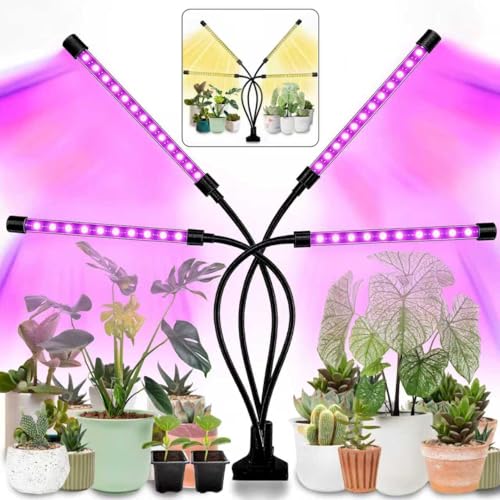
| SYEIORAOM Grow Lights For Indoor Plants | Budget-conscious vegetative growth | Four-head design with full spectrum and gooseneck flexibility |
| VIPARSPECTRA P700 Grow Light | Seedlings and dense canopies | High PAR, efficient heat management, strong output |
| GooingTop LED Grow Light | Small desks or benches with flexible placement | 6000K white light, timer options, USB or AC power |
| SDOVUERC 3-Head Plant Lights | Versatile seed starting and herbs | Three heads, memory timer, dimmable brightness |
LEOTER Grow Light For Indoor Plants
Best for compact workspaces and beginners who want a full-spectrum option with simple control. This LEOTER model uses 80 LEDs, including red, blue, yellow, and white diodes, delivering 380nm-800nm coverage for germination through flowering. It supports three timer presets (3H, 9H, and 12H) with a memory function, meaning it will repeat daily, which is convenient for a busy schedule. The unit also provides 10 dimmable levels and three spectral modes to tailor light to each growth stage. Buyers should note the timer resets if power is interrupted, a potential limitation during outages.
Who this is for: Best for small growing setups, apartment growers, and those who want a hands-off lighting schedule without needing complex configuration.
SYEIORAOM Grow Lights For Indoor Plants

Best for those who need reliable, full-spectrum coverage without a large footprint. This four-head design provides 72 high-efficiency LEDs with a full spectrum suitable for germination, vegetative growth, and budding. The gooseneck arms offer flexible positioning on shelves or plant stands, making it a solid choice for vegetables grown in indoor beds, balconies, or rooms with limited direct sunlight. The kit focuses on broad spectrum to emulate natural sunlight and supports longer seasons indoors. A potential drawback is that the design relies on ambient room conditions for cooling, so consider ventilation in warmer spaces.
Who this is for: Ideal for compact setups where space efficiency and even light distribution are priorities, especially for seedlings transitioning to leafy vegetables.
VIPARSPECTRA P700 Grow Light

Best for robust seedling growth and dense vegetable canopies. The VIPARSPECTRA P700 uses full-spectrum output with a mix of 660nm red and 3000K/5000K white light, delivering strong photosynthesis while employing a fanless heat-dissipation design through large aluminum heat sinks—helping longevity and quiet operation. It matches up to a 2×2 ft vegetative area with 70W power, delivering a high PAR while remaining energy-efficient. The main limitation is that the unit is larger and may require a fixed mounting in a grow tent or shelf setup.
Who this is for: Suitable for growers who need consistent intensity across a mid-size canopy and want energy efficiency without compromise on growth speed.
GooingTop LED Grow Light

Best for flexible placement and multi-directional lighting needs. This 6000K full-spectrum lamp uses a cluster of red and white LEDs to mimic noonday sun, and it provides a strong, flicker-free light with high color rendering. It includes programmable timer options (4H, 8H, 12H) on a 24-hour cycle, making it easy to schedule daily lighting for seedling, vegetative, and flowering phases. The USB or AC power option adds versatility. A caveat is that it may be best used as a supplementary light in larger setups because it covers a smaller area than larger panels.
Who this is for: Great for small benches, desk gardens, or as an auxiliary light to boost growth when natural light is scarce.
SDOVUERC 3-Head Plant Lights

Best for versatile seed starting and small herb or vegetable beds. This 2-pack unit features three heads with a cycle memory timer that supports 3/9/12-hour settings and 10-level brightness. The full spectrum coverage is designed to replicate natural sunlight for all growth stages, and the multi-head design focuses light more evenly across a broader surface. The main limitation is the need to manage two separate units for larger beds, which can complicate wiring and positioning in tight spaces.
Who this is for: Ideal for growers who want adjustable brightness and multi-point coverage for seedling trays or herb windowsills.
Buying Guide: How To Choose The Right Indoor Vegetable Grow Light
Key considerations help determine the best fit for your vegetable set-up.
- Light spectrum: Vegetables benefit from full spectrum with strong red and blue peaks for germination and flowering. Look for LEDs labeled full spectrum (380nm-800nm) or specific red/blue ratios aligned with growth stages.
- Coverage area: For small benches, compact multi-head units or clip-on lamps work well. For larger tents or shelves, higher-output panels like the VIPARSPECTRA P700 provide broader coverage.
- Intensity and dimming: Dimmer controls let you tailor light to seedling needs, leafy greens, or fruiting vegetables. Ten or more dimming levels offer the most flexibility across growth stages.
- Timing features: Auto ON/OFF timers reduce maintenance and support consistent daily cycles. Memory functions are helpful if you experience occasional power interruptions.
- Mounting and adjustability: Gooseneck or adjustable arms help place light directly above the canopy, improving light efficiency and reducing hot spots.
- Power and heat management: Compare wattage with the area size; look for efficient heat dissipation to extend LED life and keep temperatures stable in the growing space.
Frequently Asked Questions
- Do vegetables indoors need full-spectrum grow lights? Yes, full-spectrum lights closely mimic natural sunlight and support germination, vegetative growth, and fruiting.
- What is PAR, and why does it matter? PAR (photosynthetically active radiation) indicates the light spectrum useful to plants. Higher PAR at the canopy level typically supports faster and more uniform growth.
- How many hours of light do indoor vegetables require? Most vegetables benefit from 12-16 hours of light per day, depending on growth stage and species. Timers help maintain consistency.
- Can multiple lights be used together? Yes, but ensure even light distribution and avoid excessive heat. Use mounting strategies to cover the entire canopy.
- Is silent operation important? For indoor gardening, a quiet light with passive heat sinks is preferable to minimize ambient noise in living spaces.
- Are cool-white vs. warm-white lights better for vegetables? A balanced mix (cool and warm white with red/blue accents) typically supports more balanced growth across stages.