Answering the question “how can I grow microgreens indoors for profit?” with proven kit options that simplify planting, watering, and harvesting. These picks suit buyers who want fast, low-muss microgreens on countertops or in small grow spaces, with potential for weekly harvests. Ideal for: home-based sellers, meal-prep services, or hobbyists turning herbs into a small income. The following sections compare each kit’s strengths, best uses, and limitations to help you choose.
| Product | Best For | Why It Stands Out |
|---|---|---|
| Organic Self-Watering Microgreens Growing Kit | Beginner growers seeking soil-free setup | Includes reusable tray, bamboo surround, hydroponic insert, and grow mats; offers soil option later for larger seeds |
| Self Watering Microgreens Growing Kit | Weekly harvests for busy cooks | Comprehensive kit with seeds, mats, tray, and bamboo frame; supports soil or hydroponic growth |
| Microgreen Growing Trays, 5″ x 5″ Sprouting Tray (4 Pack) | Small batches or mini kitchens | Multiple humidity domes and mesh trays; dishwasher-safe bottom tray for easy cleanup |
| RMBHM Microgreens Growing Trays Kit – 6 Pack | Moderate-scale urban growing | Six trays with hemp fiber grow mats; compact footprint for countertops or shelves |
Organic Self-Watering Microgreens Kit — Reusable Tray
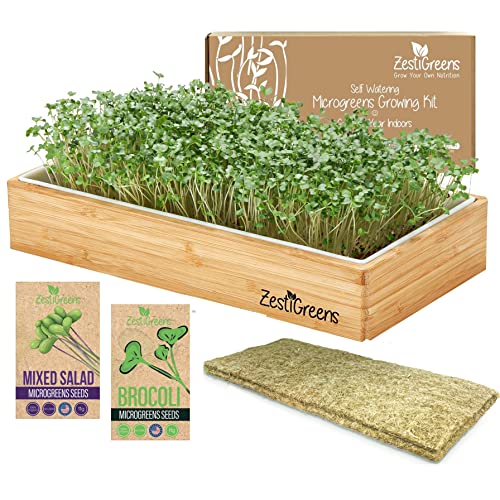
The Organic Self-Watering Microgreens Growing Kit offers a soil-free start with a reusable 12″ x 6″ tray surrounded by bamboo. It includes hydroponic inserts, blackout lid, two hemp mats, and seed packs for Red Garnet Amaranth and a broccoli-kale mix. A 16-page illustrated guide supports beginners and experienced growers alike. Best for kitchen counters and a quick weekly harvest cycle. Choose this if you want a flexible setup that can shift from hydroponics to soil later for larger microgreens varieties. Caution: some larger seeds grow better in soil, so plan for potential adjustments.
Self Watering Microgreens Growing Kit

This kit emphasizes ease with a top-quality microgreens tray, bamboo surround, hydroponic insert, two hemp mats, blackout lid, and seed packets for Amaranth Red Garnet plus a Broccoli-Kale-Kohlrabi-Arugula-Cabbage mix. It supports growing all microgreens varieties and allows removing the hydroponic insert to use soil for larger seeds. Best for buyers who want a reliable weekly harvest with optional soil flexibility. Limitation: some seed varieties may perform better with soil-only setups.
Microgreen Growing Trays — 5″ x 5″ Sprouting Trays (4 Pack)

This 4-pack offers compact 5″ x 5″ trays with a 1.2 mm seed hole size and a 1.2 mm mesh design, plus a bottom reservoir tray. The humidity domes optimize germination, and the trays are BPA-free for safe indoor growing. Best for microgreens sprouting in small spaces or as starter units for a scalable system. Better for beginners who want a straightforward, modular setup. Caution: domes are not dishwasher-safe; hand-wash to extend life.
RMBHM Microgreens Growing Trays Kit — 6 Pack

The RMBHM kit includes six durable grow trays with 12 hemp fiber grow mats designed for soil-free indoor microgreens or seedlings. Each tray measures 15 x 11 x 2.5 inches, providing ample root space while remaining compact for countertops, shelves, or window sills. Best for buyers expanding from a single tray to a small, multi-tray system. Caution: ensure adequate air circulation to prevent mold in densely packed setups.
Buying Guide: Key Buy Considerations For Indoor Microgreens Profit
- Growing method: Decide between hydroponic (no soil) vs. soil-based options. Hydroponic setups can be cleaner and faster, while soil methods may support a wider range of seeds.
- Space and scalability: Start with compact trays if space is limited; choose kits that scale with additional trays and mats.
- Water management: Look for self-watering or bottom-water designs to minimize daily maintenance and reduce overhead costs.
- Seed compatibility: Some seeds thrive in hydroponics; larger seeds usually perform better in soil. Verify included seed varieties and consider adding your own seeds.
- Materials and cleanliness: BPA-free plastics, food-grade materials, and easy-to-clean components save time and support food-safety goals.
Multiple Perspectives: Practical Buyer Questions
- What is the quickest route to a harvest? Kits with hydroponic inserts and pre-seeded mats typically yield in 7–10 days.
- Is soil necessary? Some kits allow removing the hydroponic insert to grow with soil, offering flexibility for larger seed varieties.
- What space is required? Most kits fit on kitchen counters, tables, or compact shelves; modifiable trays help maximize a small footprint.
- How easy is cleanup? Look for dishwasher-safe bottom trays and BPA-free materials to simplify maintenance.
FAQ
- Q: Can microgreens be grown year-round indoors? A: Yes, with proper watering and light management, though direct sunlight or grow lights may influence growth rate.
- Q: Are these kits suitable for selling microgreens to customers? A: They are designed for home growth; scaling to selling requires additional infrastructure and compliance checks.
- Q: Do I need special lights? A: Most kits do not require special lighting, but supplemental light can speed growth for shelf-life and productivity.
- Q: What is the typical harvest window? A: Most microgreens are ready in 7–14 days from sowing, depending on variety and conditions.
- Q: How do I prevent mold in humid environments? A: Ensure good airflow, clean trays promptly, and avoid overwatering in tight spaces.