Gardening success often hinges on keeping pests in check while protecting beneficial insects and the harvest. The following insecticides and miticides offer a range of approaches—from soap and neem-based formulas to spinosad concentrates—that work in home gardens, containers, and indoor greenhouses. This guide highlights five products that balance efficacy with organic or low-toxicity considerations, helping American gardeners choose the right tool for their needs.
| Product | Brand | Type / Use | Organic / Safe for Edibles |
|---|---|---|---|
| Garden Safe 32 oz Insecticidal Soap | Garden Safe | Contact spray for a broad range of pests | Yes (organic gardening friendly) |
| Bonide Pyrethrin Garden Insect Spray Concentrate | Bonide | Concentrate for quick, fast-acting control | Yes (pyrethrin derived) |
| Garden Safe Fungicide3 32 oz | Garden Safe | Fungicide, insecticide & miticide combo | Yes (organic gardening) |
| Earth’s Ally 3-in-1 Plant Spray 32 oz | Earth’s Ally | Insecticide, miticide & fungicide trio | Yes (organic-friendly) |
| Monterey Spinosad Insecticide 8 oz | Monterey | Spinosad-based control for many insects | Yes (OMRI Listed) |
Each product below is presented with a concise overview, key uses, and a look at how its active ingredients align with common garden scenarios—whether you’re protecting vegetables, ornamentals, or indoor houseplants. The list draws from trusted brands known for household-friendly pest control options that minimize disruption to beneficial insects when used as directed.
Garden Safe 32 oz Insecticidal Soap Ready-to-Use

The Ready-to-Use Insecticidal Soap from Garden Safe provides direct-contact pest control without mixing. It treats the underside of leaves and all plant parts where pests hide, making it suitable for vegetables, fruit trees, ornamentals, shrubs, and flowers. This product suits organic gardening goals and can be used indoors, outdoors, or in greenhouses. It is approved for use up to the day of harvest on edible crops, emphasizing a grower-friendly approach to routine pest management.
Key considerations: Use direct contact on pests for visible results; avoid hot sun or stressed plants to prevent leaf burn; best applied when pests are first seen for rapid suppression. Because this is a contact spray, thorough coverage of affected tissue is essential. Ideal for sudden outbreaks of aphids, whiteflies, scale, and other soft-bodied pests on a wide range of garden plants.
Bonide Pyrethrin Garden Insect Spray Concentrate

This ready-to-mix concentrate uses pyrethrin to quickly kill aphids, beetles, webworms, leafhoppers, and other common garden insects. Designed for outdoor use on a broad range of plants—from vegetables like beans and peppers to ornamentals such as roses and azaleas—this product leverages a natural botanical insecticide derived from chrysanthemum flowers. Pyrethrin acts by targeting the nervous system of insects, delivering rapid knockdown with a biodegradation-friendly profile when used as directed.
Considerations: Concentrates require proper dilution, so follow label instructions carefully. The spectrum is broad, so use targeted applications on susceptible plants to minimize impact on beneficial insects. Suitable for seasonal pest pressure in home gardens, especially when quick action is needed on common pests that resist other treatments.
Garden Safe Fungicide3 32 Fl Oz

Garden Safe Fungicide3 blends fungicide, insecticide, and miticide actions in a single 32-ounce bottle, offering three modes of defense for organic gardening. Neem oil extract is included to support broader protection against diseases like black spot, rust, and powdery mildew while simultaneously addressing a spectrum of insect pests. This integrated approach reduces the need for multiple products and can be convenient for gardeners managing multiple threats across diverse crops.
Key points: Effective for prevention and control of fungal diseases; suitable for roses, ornamentals, fruits, and vegetables; compatible with general IPM practices. Because neem oil is a natural component, be mindful of weather conditions that can affect efficacy and potential phytotoxicity on sensitive plant species during high heat.
Earth’s Ally 3-in-1 Plant Spray 32 oz

Earth’s Ally 3-in-1 Plant Spray combines insecticide, miticide, and fungicide in one formula. Its botanical oil blend targets soft-bodied insects like spider mites, aphids, whiteflies, mealybugs, and scale, while also helping to suppress common plant diseases such as powdery mildew and leaf spot. This product is suitable for both indoor houseplants and outdoor plantings, making it versatile for mixed-use spaces and seasonal pest pressures.
Considerations: The 3-in-1 approach can reduce the number of sprays needed, but performance depends on thorough coverage and repeated applications in heavy pest scenarios. It’s a good fit for mixed gardens where pest and disease pressure overlaps, especially on a tight spray schedule aligned with pest life cycles.
Monterey Spinosad Insecticide 8 oz
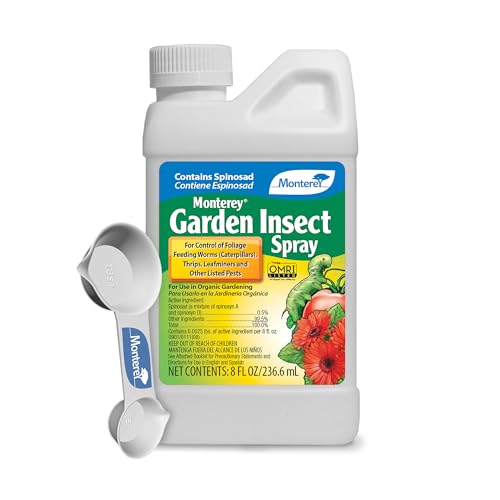
Monterey Spinosad Insecticide relies on spinosad, a naturally occurring bacterial product, to control a broad spectrum of pests. It is effective against caterpillars, leafminers, codling moths, tent caterpillars, gypsy moths, thrips, borers, fire ants, and more. The product is OMRI-listed for organic gardening, helping gardeners pursuing organic standards. It’s particularly useful for fruit trees, citrus, vegetables, and outdoor ornamentals, providing systemic-like activity with contact kill dynamics.
Usage notes: Spinosad works best on actively feeding insects. Apply during calm conditions to maximize coverage and minimize drift. For best results, rotate with other modes of action to prevent resistance, and follow the label for safe use on edible crops and harvest intervals.
Buying Guide
Important factors to consider when selecting a garden insecticide:
- Efficacy against target pests: Identify the most common pests in your area and choose products with proven activity against those species. For example, soft-bodied pests respond well to contact sprays, while caterpillars and beetles may require broader-spectrum or systemic options.
- Mode of action: Rotate among different active ingredients (soap, pyrethrins, neem-based formulations, spinosad, etc.) to reduce the risk of pest resistance and protect beneficial insects when used per label directions.
- Organic compatibility: If you garden for organic certification or prefer low-toxicity products, prioritize OMRI-listed or naturally derived formulations such as spinosad or neem-based products while understanding any crop harvest restrictions.
- Edible crops and harvest timing: Some products allow application up to the day of harvest, while others require pre-harvest intervals. Plan applications to avoid residue on edible parts where indicated.
- Indoor vs. outdoor use: Houseplants and greenhouse setups may require gentler sprays with minimal residual impact. Verify label guidance for indoor environments and spray safety for homes with children or pets.
- Application coverage: Thorough coverage often determines success, particularly with contact sprays. Muscular misting or targeted leaf undersides improve efficacy without overspray on non-target areas.
- Environmental conditions: Temperature, wind, and sunlight influence spray performance and potential phytotoxicity. Apply during favorable weather to minimize plant stress and off-target effects.
In practice, a diversified approach often yields the best results. Pair a contact spray for immediate knockdown with a preventive or disease-control product that supports plant health across leaves, stems, and fruiting tissues. Always follow label directions, perform spot tests on sensitive plants, and monitor pest populations to adjust strategies over the growing season.