When choosing a lake water pump for irrigation, you want reliable flow, solid durability, and easy operation. This guide highlights five top options suited for different buyers: homeowners needing simple lawn irrigation, small farms seeking steady water transfer, and gardeners prioritizing durability and simple setup. Below, you’ll find concise comparisons, who each pump is best for, and practical considerations to help you pick the right model for your needs.
| Product | Best For | Key Benefit |
|---|---|---|
| Aquastrong 115V Shallow Well Garden Pump | Small to medium lawns and gardens | High head, stainless steel, compact |
| Red Lion RL-SPRK150 | Well water or lake water users needing dual voltage | Cast iron, dual voltage, easy priming |
| ECO-WORTHY 33-Series | Quiet operation with pressure-controlled on/off | Diaphragm design, adjustable 45–70 PSI |
| AQUASTRONG 1.5 HP Jet/Centrifugal | Higher flow for larger lawns or fields | High GPH, flexible voltage |
| Aquastrong 115V Shallow Well With Pressure Tank | Domestic water supply and garden irrigation | Pressure tank, automatic switch, durable stainless steel |
Aquastrong 115V Shallow Well Garden Pump

Best for high head requirements and durable build. This 1.6 HP model delivers up to 164 ft of head and up to 1320 GPH at 5 ft, making it suitable for lifting lake water to sprinklers or elevated irrigation zones. Features stainless steel casing and corrosion-resistant components with a built-in thermal protector. It is not self-priming, so priming is required before first use. Best for: homeowners needing strong suction for mid-size lawns and gardens. Limitation: requires manual priming and water filling prior to operation.
Red Lion RL-SPRK150 115/230V

Best for mixed voltage setups and robust construction. Features a rugged cast iron housing and a dual-voltage motor (115/230V) with a thermoplastic impeller. One-time priming is required, with straightforward priming instructions. Best for: users who may switch power sources or require reliable operation with lake or well water. Limitation: priming is needed after initial setup and switching voltages may require manual adjustment.
ECO-WORTHY 33-Series Diaphragm Pump
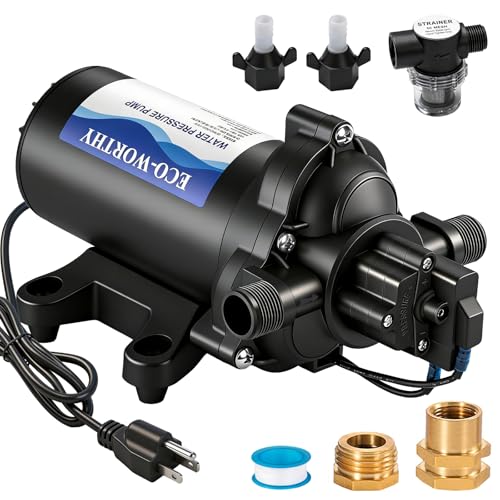
Best for quiet, pressure-controlled irrigation. This diaphragm pump runs on 110V AC and supplies about 4.0 GPM at 50 PSI. It includes a smart pressure switch for on-demand operation and a compact system with a 9.8 ft self-priming lift and built-in thermal protection. Best for: small irrigation setups and RV or garden applications where a quiet, auto-adjusting pump is ideal. Limitation: lower total head compared to high-pressure jet pumps; verify head needs before installation.
AQUASTRONG 1.5 HP Jet/Centrifugal Pump

Best for large irrigation flows and heavy-duty use. Delivers up to 4250 GPH with a 108 ft head, featuring a 2″ NPT suction and 1.5″ NPT discharge. It offers dual voltage (115/230V) with an efficient motor and a reinforced impeller/diffuser. Best for: lawns or gardens needing substantial water volume and high head. Limitation: larger footprint and weight; installation space matters.
Aquastrong 115V Shallow Well Garden Pump With Pressure Tank
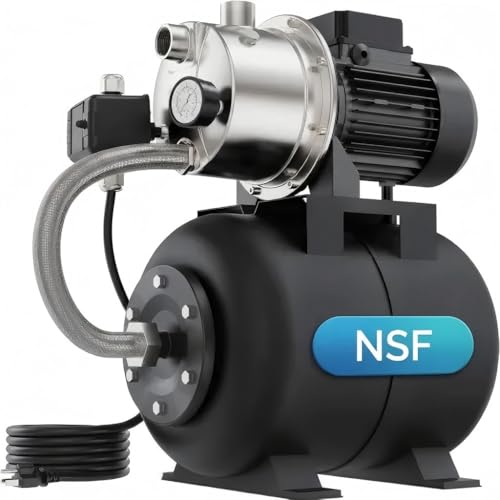
Best for integrated home irrigation with steady pressure. This model combines a 1.6 HP shallow well jet pump with a compact 5-gallon pressure tank, a pressure switch for automatic start/stop at 20–40 PSI, and a pressure gauge. The stainless steel housing provides corrosion resistance, and the package includes a built-in waterproof switch. Best for: homeowners seeking a simple, auto-regulating system for garden irrigation. Caution: ensure the pressure tank is properly sized for your system and check local wiring requirements.
Buying Guide: Lake Water Irrigation Pumps
- Head and flow requirements: Match the pump head (feet) and GPH to your sprinkler layout and elevation changes. Higher heads mean less flow at distant zones.
- Water source and compatibility: Lake or well water often contains particulates. Look for pump bodies with corrosion resistance and simple filtration options. For drinking-water roles, NSF-certified components may be important.
- Voltage and power: Dual-voltage pumps offer flexibility but ensure the source matches the unit’s rating. Check for a transformer or manual voltage switch if required.
- Priming needs: Some models are not self-priming. Be prepared to fill the pump housing or use a priming method before first use.
- Automatic operation: Pressure switches and tanks provide automatic on/off cycling. This reduces manual control but adds components to manage and maintain.
- Durability and maintenance: Stainless steel housings and cast-iron components offer longevity in outdoor environments. Consider thermal overload protection to prevent motor damage.
- Installation space and noise: Larger pumps require more space and may generate more noise. If noise matters, select quieter diaphragm or pump designs with insulation features.
FAQ
- What is a good GPH for residential lake irrigation? – For small to mid-size lawns, 1000–1500 GPH is usually sufficient, depending on head height and sprinkler spacing.
- Do I need a pressure tank with lake water pumps? – A pressure tank stabilizes water pressure and extends pump life by reducing cycling. It’s common in home irrigation setups.
- Is self-priming essential? – Self-priming simplifies initial setup, but non-self-priming models can be used with proper priming before operation.
- Can I use a 115V pump with a lake source? – Yes, as long as the pump’s inlet can draw from the lake and head requirements are met. Verify voltage compatibility with your power supply.
- What maintenance matters most? – Regularly check seals, cabling, and pressure settings. Clear debris from intakes and ensure the thermal protection remains functional.
- Which pump is best for large gardens with high head? – Pumps with higher GPH and head ratings, such as the jet/centrifugal options, are better suited for substantial irrigation networks.