Liquid fertilizers offer fast-acting nutrition for a wide range of plants, from houseplants to outdoor beds. This guide highlights five top options and explains who each one is best for, plus practical buying tips. Ideal buyers include busy homeowners seeking instant feeding, indoor gardeners wanting simple applications, and even those growing fruiting plants that benefit from quick nutrient boosts.
Summary of selected products:
| Product | Brand | Best For |
|---|---|---|
| Miracle-Gro Pour & Feed Plant Food | Miracle-Gro | Container plants, indoor and outdoor, instant feeding |
| Miracle-Gro Liquid All Purpose Plant Food | Miracle-Gro | All plant types, versatile use, quick nourishment |
| Miracle-Gro Organic Plant Food | Miracle-Gro | Organic gardening, plant-based nutrients |
| Miracle-Gro LiquaFeed All Purpose Plant Food Advance Starter Kit | Miracle-Gro | Easy feeding in-ground or containers, starter set |
| Grow Queen Organic Liquid Indoor Plant Food | Grow Queen | Organic indoor feeding, 5-5-5 formula with sea kelp |
Miracle-Gro Pour & Feed Plant Food

Best for: Container plants and quick indoor/outdoor feeding. This ready-to-use formula requires no mixing; simply apply the liquid directly to the soil. It feeds potted plants and flowers instantly, making it ideal for busy households with a mix of houseplants and outdoor containers.
Why selected: The convenience of no diluting or mixing reduces setup time and potential dosing errors. It targets container-grown plants, delivering rapid feeding directly where roots can access nutrients.
Caution: Avoid over-application; follow the recommended amount per pot to prevent nutrient burn on sensitive foliage.
Miracle-Gro Liquid All Purpose Plant Food

Best for: A versatile, all-purpose solution for flowers, vegetables, trees, and houseplants. Use this concentrate by mixing with water in a watering can for broad-spectrum feeding.
Why selected: It supports a wide range of plant types with one product, making it convenient for households growing diverse plant species.
Caution: Requires a mixing step; accuracy in dilution is important to avoid under- or over-feeding.
Miracle-Gro Organic Plant Food

Best for: Organic gardening indoors or outdoors. This liquid plant food is made from plant-based ingredients and OMRI listed, suitable for various plant types when used as directed.
Why selected: Provides an organic alternative that supports organic gardening goals while still delivering quick plant nutrition to support resilience and growth.
Caution: Organic formulations can have slower visible effects than synthetic options; it’s important to follow feeding intervals and directions for best results.
Miracle-Gro LiquaFeed All Purpose Plant Food Advance Starter Kit

Best for: Gardening enthusiasts seeking an easy feeding system for in-ground gardens or outdoor containers. The kit combines plant food with a feeder for simple, consistent application.
Why selected: The integration of a feeder simplifies regular feeding, enabling uniform nutrient delivery to a variety of plant types, including flowers, vegetables, trees, and shrubs.
Caution: The kit’s feeder system may require setup and maintenance; monitor for clogs or leaks if used in tight containers or small pots.
Grow Queen Organic Liquid Indoor Plant Food
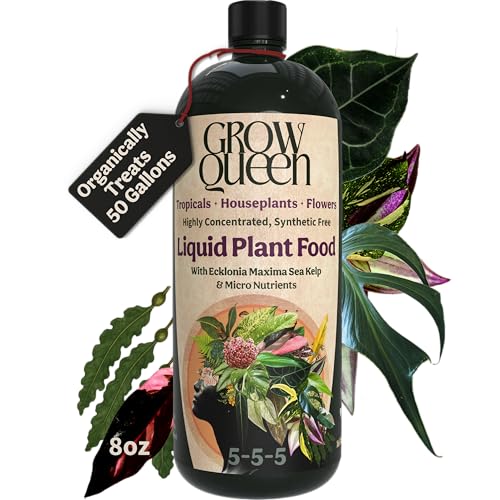
Best for: Organic, indoor plant care using a true 5-5-5 formula with sea kelp. Suitable for daily feeding without burning sensitive foliage.
Why selected: Combines a balanced NPK with sea kelp and living nutrients, designed to boost vigor while supporting soil microbiology and easier indoor maintenance.
Caution: Some users may prefer stronger nitrogen for leafy growth; monitor plant response and adjust frequency accordingly.
Buying Guide
What to consider when choosing liquid plant fertilizer:
- Plant type compatibility: Do you need a universal formula or something tailored to indoor houseplants, vegetables, or fruiting plants?
- Concentration and dilution: Are you comfortable mixing concentrates, or do you prefer ready-to-use applications?
- Organic vs synthetic: Is an organic option important for your gardening goals or food-growing practices?
- Container vs in-ground use: Some formulas are optimized for containers; others are versatile for beds and garden soils.
- NPK balance: A balanced 5-5-5 or similar ratio supports steady growth, while higher nitrogen can boost leafy vigor and higher phosphorus can aid flowering.
- Portability and ease: Starter kits with feeders simplify regular feeding, especially for busy schedules.
Practical tips for using liquid fertilizers
- Follow label directions precisely to avoid nutrient burn.
- Apply during the plant’s active growth phase for best uptake.
- Watering considerations: some formulas feed directly through soil; others require dilution in water before application.
- Test a few plants first to observe response before broadening usage.
FAQ
- Q: Can I use liquid fertilizer on all houseplants? A: Most are formulated for a wide range of houseplants, but check the product label for any plant-type restrictions.
- Q: How often should I apply liquid plant food? A: Frequency depends on the product and plant needs; follow the label and adjust by plant response.
- Q: Is organic liquid fertilizer as effective as synthetic? A: Organic options support sustainable gardening and soil life, but may show slower visible results; combine with proper soil care.
- Q: Do I need a feeder with liquid fertilizer? A: Some kits include a feeder for easier application; others are ready-to-use or require mixing in a watering can.
- Q: Can I use liquid fertilizer for edibles grown in containers? A: Yes, many formulas are suitable for vegetables and herbs when used as directed, including in containers.
- Q: Will liquid fertilizer burn my plants? A: Over-application or improper dilution can cause nutrient burn; always adhere to label guidance and start with lower doses if uncertain.