Direct answer: choose a moisture meter that fits your plant type and pot size, offers clear readings, and requires no batteries where possible. For indoor houseplants, compact meters with root-zone probes work best; for outdoor or large pots, long-probe models excel. The top picks below are selected for reliability, ease of use, and practical plant care guidance. Best suited buyers include beginners seeking simple guidance, hobbyists managing mixed plant collections, and serious gardeners needing quick root-zone readings.
Summary table of selected products:
| Product | Best For | Key Point |
|---|---|---|
| XLUX Long Probe Deep Use Soil Moisture Meter | Deep pots, outdoor herbs, large houseplants | Long 5.5″ probe for root-zone depth; immediate read |
| Antonki 2 Pack Soil Moisture Meter | Beginner to intermediate, multiple planters | Color-coded dial with 10 scales; no batteries |
| YAMRON 4-in-1 Soil Moisture Meter | All-in-one care with pH & temperature | Moisture, pH, temperature, sunlight; backlit display |
| Censinda Soil Moisture Meter | No-battery simple testing | Battery-free; quick dry/moist/wet reading |
| Aenncci 2-in-1 Soil Test Kit | Soil moisture plus pH for precise care | Dual dial; battery-free; easy root-zone testing |
XLUX Long Probe Deep Use Soil Moisture Meter

The XLUX Long Probe Deep Use Moisture Meter provides an extended 14 cm (5.5 inch) probe to reach the root zone of larger pots or garden beds. It reads dry, moist, or wet soil instantly without batteries. The large dial with ten scales and three zones makes interpretation straightforward for both novices and seasoned gardeners. Use best for deep pots, outdoor planters, and plants where surface readings mislead. Caution: do not leave the metal tip in soil for more than five minutes to avoid corrosion.
XLUX Soil Moisture Meter (Since 2015) — 304 Stainless Steel Probe
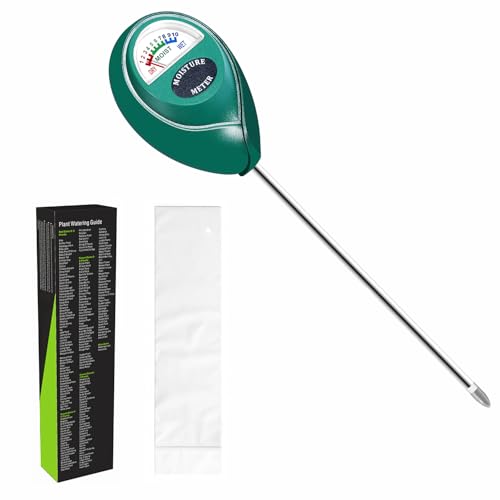
XLUX’s upgraded meter uses a durable 304 stainless steel probe and a battery-free design, delivering immediate root-zone moisture readings. Its 10-scale dial (Dry-Moist-Wet) supports clear watering decisions. Best for users who want long-term reliability and straightforward operation. Choose this if you value a proven track record and steady accuracy for a range of indoor and outdoor plants.
Antonki 2 Pack Soil Moisture Meter

Antonki provides two meters per pack with a simple, color-coded dial: red for DRY, green for MOIST, blue for WET across 10 scales. No batteries are required. This set is ideal for households with multiple plants or different pot sizes. Best for beginners who want immediate, easy-to-interpret guidance. Limitation: readings can vary slightly with soil type and compaction, so cross-check with a separate plant cue if needed.
SONKIR Soil pH Meter, 3-in-1 Tester

SONKIR offers a three-in-one tester focusing on moisture, pH, and sunlight, suitable for garden beds and lawns. Battery-free operation is common, and the device helps avoid overwatering by indicating moisture levels beyond the surface. Best for gardeners who want a compact, multi-parameter tool, with a caution that accuracy can vary in very dry or highly acidic soils.
YAMRON 4-in-1 Soil Moisture Meter

YAMRON combines moisture, pH, temperature, and sunlight readings in one device, with a backlit LCD for easy visibility day or night. It uses four batteries and reports battery status as well. Best for gardeners who want comprehensive, on-the-spot readings in a single tool. Choose this if you need more environmental data to fine-tune watering and care; may be heavier and require battery management.
Aenncci 2-in-1 Soil Test Kit

Aenncci’s 2-in-1 kit combines soil moisture and pH monitoring with a clear dual dial. It is battery-free and designed for quick root-zone checks. Best for users who want straightforward dual-parameter feedback without extra features. Limitation: readings can be influenced by soil density and temperature, so interpret within context.
Buying Guide: Practical Tips For Choosing The Right Moisture Meter
- Soil depth and pot size: Choose a longer probe for large pots or garden beds, and a shorter probe for small pots.
- Power source: Battery-free meters are simple and low-maintenance, but some models include digital displays and extra sensors requiring batteries.
- Reading clarity: Prioritize meters with clear color-coding and large dials for quick interpretation.
- Multi-function needs: If you want soil pH, temperature, or light data, consider 3-in-1 or 4-in-1 models, but balance with ease of use and price.
- Soil compatibility: Some meters read best in evenly moist soil; very sandy or very clay-heavy soils may affect accuracy. Calibrate expectations accordingly.
- Maintenance: Probes can corrode or accumulate soil residue. Clean after use and avoid leaving metering tips submerged for extended periods.
- Usage tips: Insert to root zone for accurate readings; avoid testing near surface-only or overwatering conditions; if some zones differ, water evenly across the root zone.
Frequently Asked Questions
- What is the main purpose of a soil moisture meter?
– To assess moisture at the plant root zone so you can water appropriately and prevent root rot or underwatering. - Do I need batteries for a moisture meter?
– Many meters are battery-free; some offer digital displays or additional sensors that require batteries. - How deep should I insert the probe?
– Insert deep enough to reach the root zone, typically two-thirds of the pot depth, or according to the device’s guidance. - Can these meters work for outdoor gardens?
– Yes, longer-probe models are designed for outdoor pots and garden beds, but avoid prolonged exposure to moisture on metal tips to prevent corrosion. - Are pH meters necessary for all plants?
– Not for every plant, but for many acid-loving or soil-sensitive varieties, monitoring pH helps optimize nutrient availability. - Which meter is best for beginners?
– Meters with simple color-coded dials and no battery requirement are typically easiest for beginners to start with.