When growing tomatoes, the right plant food can significantly boost growth, fruit size, and overall yield. This guide highlights five top tomato-focused fertilizers, explaining who each product is best for, and why you might choose one over another. It’s ideal for home gardeners, container growers, and vegetable plot planners looking for reliable, easy-to-use options.
Summary table of selected products
| Product | Best For | Key Benefit | Notes |
|---|---|---|---|
| Miracle-Gro Water Soluble Tomato Plant Food | General use, weekly feeder | Fast-acting feed for bigger vegetables | Feeds every 1-2 weeks |
| Miracle-Gro Shake ‘N Feed Tomato, Fruit & Vegetable | Long-lasting, easy to apply | Feeds up to 3 months | Calcium included for stronger cell walls |
| Miracle-Gro Water Soluble Tomato Plant Food (3 lb) | Large garden areas | Broad coverage, high efficiency | Feeds approx. 1,200 sq ft |
| Burpee Organic Tomato & Vegetable Granular Plant Food | Organic option, long-lasting | Granular sustenance for up to 3 months | Organic formula |
| Espoma Organic Tomato Plant Food | Organic, easy liquid feeding | Kid- and pet-friendly use | Liquid, mix-and-drench |
Miracle-Gro Water Soluble Tomato Plant Food
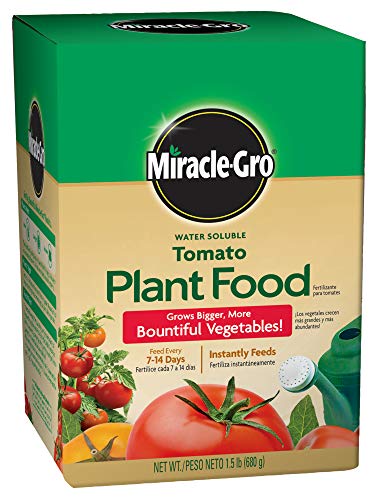
Product overview: Miracle-Gro Water Soluble Tomato Plant Food is a fast-acting fertilizer designed to feed vegetables, including tomatoes, when dissolved in water. It is intended to boost growth and yield by delivering nutrients in a readily absorbed form.
Best for: Home gardeners who want quick results and a reliable schedule. It’s suitable for tomatoes grown in-ground or in large containers and works well for those who prefer weekly or biweekly feeding cycles.
Why selected: It emphasizes noticeable growth improvements and straightforward application, aligning with gardeners seeking predictable, regular results.
Caution: Avoid over-fertilizing—follow the recommended dilution and feeding frequency to prevent leaf burn or overly lush foliage with fewer fruits.
Miracle-Gro Shake ‘N Feed Tomato, Fruit and Vegetable Plant Food

This granulated formula feeds up to three months, delivering nutrients both above and below the soil. It also includes calcium to help strengthen cell walls, supporting better quality and longer-lasting fruits and vegetables.
Best for: Gardeners who want a low-maintenance feeding plan with extended coverage and calcium support for sturdier fruit development.
Why selected: The long-lasting feeding cycle reduces the frequency of applications while promoting robust plant structure and fruit quality.
Limitation: It requires initial even distribution and occasional soil mixing to ensure uniform nutrient availability in larger beds or containers.
Miracle-Gro Shake ‘N Feed Tomato, Fruit & Vegetable Plant Food (1 lb)

Product overview: Similar to the larger shake, this 1 lb pack feeds for up to three months and includes calcium to help form stronger cell walls in fruits and vegetables.
Best for: Smaller gardens or those who prefer a compact option with the same long-term feeding benefits as the larger bag.
Why selected: It preserves the long-cycle feeding advantage while offering a portable, easy-to-store option for compact spaces.
Caution: As with all granular formulas, water the soil after application to help dissolution and distribution of nutrients.
Miracle-Gro Water Soluble Tomato Plant Food (3 lb)

This 3 lb box covers a larger garden area and uses a water-soluble formula to maximize uptake by vegetable plants, specifically designed to help grow more bountiful vegetables than unfed plants.
Best for: Gardeners with substantial garden plots or multiple tomato beds who need broad coverage and regular, efficient feeding.
Why selected: The broad coverage and compatibility with water-based application methods align with larger spaces and automated watering systems.
Limitation: It requires proper mixing and ongoing dilution accuracy to prevent concentrated spots in the garden.
Burpee Organic Tomato & Vegetable Granular Plant Food

Product overview: An organic granular fertilizer that releases nutrients gradually to support long-lasting results over a growing season. It nourishes tomatoes and other vegetables in-ground or in containers.
Best for: Gardeners seeking an organic option with extended feeding, and those who prefer a slow-release approach for steady growth.
Why selected: Its organic formulation suits buyers prioritizing natural inputs while still delivering reliable performance. It’s a good match for organic or low-synthetic gardening plans.
Limitation: Granular formats may require more careful soil integration and slower initial nutrient availability compared with water-soluble options.
Jobe’s Garden Fertilizer Spikes (18 Count)

Product overview: These tomato fertilizer spikes provide a controlled release of nutrients directly below the surface, targeting active roots with minimal runoff and odor. The formula is 6-18-6 NPK.
Best for: Gardeners who want a simple, in-ground feeding solution at planting or early in the growing season, with reduced maintenance afterward.
Why selected: Spikes offer a clean, hands-off approach that reduces fertilizer waste and mess while feeding over time.
Limitation: Spikes require correct placement at root zones; inconsistent placement can lead to uneven nutrient access.
Espoma Organic Tomato Plant Food (Liquid)

Product overview: An organic liquid fertilizer for tomatoes and vegetables that’s safe for home use around kids and pets. Mixes with water for easy application and should be used every 2-4 weeks for best results.
Best for: Organic gardeners who prefer liquid feeding and frequent, predictable watering routines in versatile soil conditions.
Why selected: It combines organic safety with straightforward dosing, making it appealing for households prioritizing pet-friendly gardening practices.
Limitation: Liquid formats may require more frequent applications to sustain nutrient levels between feedings.
Buying Guide: How To Choose The Right Tomato Fertilizer
What should you consider before buying?
- Organic vs. synthetic: Do you want a natural option or fast-acting synthetic nutrients?
- Feeding frequency: Are you looking for long-lasting feeds or quick, regular boosts?
- Application method: Do you prefer water-soluble liquid, granular, spikes, or shake-and-feed formats?
- Coverage area: How large is your garden, bed, or container setup?
- Calcium and structure: Do you need calcium for stronger fruit walls and reduced cracking?
- Container vs. in-ground: Some formulas work better in containers; others are designed for beds.
Practical tips for using tomato plant food
- Follow label directions for dilution and application intervals to avoid leaf burn or nutrient lockout.
- Water thoroughly after applying granular or spike feeds to distribute nutrients evenly.
- Combine fertilizer with healthy soil practices: compost, mulch, and regular watering patterns.
- Seasonal timing matters; start feeding at transplant or first signs of growth and continue through fruit set.
Frequently Asked Questions
- What type of fertilizer is best for tomatoes?
- How often should I fertilize tomatoes?
- Should I use calcium in tomato fertilizer?
- Is organic fertilizer safe for kids and pets?
- Can I use tomato fertilizer on other vegetables?
- What is the best option for container tomatoes?
Both organic and synthetic options can be effective. Choose based on your gardening philosophy, how quickly you want results, and whether you prioritize soil health or ease of use.
Typical schedules range from every 1-2 weeks for water-soluble feeds to every 1-3 months for long-lasting granules. Follow product directions for best results.
Calcium helps form stronger cell walls, reducing fruit cracking and blossom end rot. Many formulas include calcium or can be supplemented separately.
Organic products are generally safer for households with kids and pets, but always follow label directions and store products properly.
Most tomato-focused plant foods also support other vegetables, but check labels to confirm compatibility with your crop mix.
Liquid or soluble feeds that are balcony- and container-friendly, with clear dilution instructions, work well for pots and small spaces.