Answering the common question, these pop-up drainage emitters are designed to move stormwater away from foundations, fences, and lawns by releasing collected water at a safe downstream point. They’re best for homeowners managing yard runoff, property with erosion-prone areas, or projects needing robust lawn-traffic compatibility. The top picks here fit either 3-inch or 4-inch sewer and drain fittings and work with catch basins, channel drains, and downspouts. Below, five emitters are compared to help you choose the right fit for your drainage system and yard layout.
Summary of chosen products:
| Product | Best For | Key Benefit |
|---|---|---|
| NDS 420C Pop-Up Drainage Emitter | General yard drainage with pedestrian access | Handles up to 40 GPM; compatible with 3″ & 4″ fittings; outside flange prevents grass covering |
| NDS 422G Pop-Up Drainage Emitter with Elbow | Downstream discharge with elbow routing | Low-point discharge, easy elbow connection to 4″ pipe |
| Avanhitch 4″ Pop Up Drainage Emitter with Elbow | 4″ pipe systems with universal 3″-4″ compatibility | Dual-rod, spring-free, directs flow away from structures |
| Avanhitch Pop Up Drainage Emitter (3″ & 4″) | Hybrid 3″ and 4″ systems | Low-profile top; dual-rod open/close; lawn-friendly |
| Avanhitch 3″/4″ Pop Up Drainage Emitter with Elbow | Downspouts and yard outlets with elbow | Integrated elbow outlet; direct 3″ or 4″ compatibility; dual-rod |
NDS 420C Pop-Up Drainage Emitter
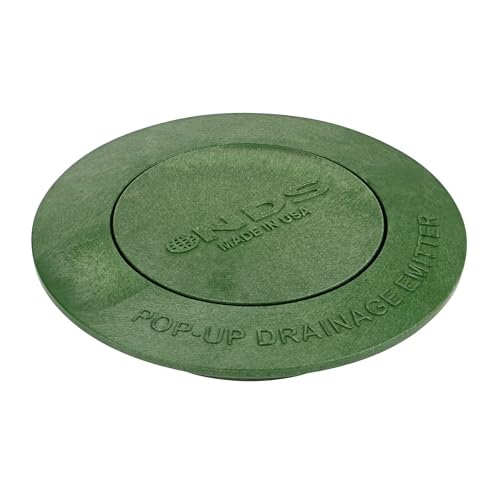
The NDS 420C is designed to release collected stormwater through 3″ or 4″ sewer and drain fittings. It works with catch basins, channel drains, and similar drainage components to move water away from structures and erosion-prone areas. Best for properties needing a reliable emitter that supports pedestrian traffic when properly installed. A caution: installation stability depends on the downstream slope and proper anchoring; check local conditions to avoid mower strikes.
- Releases up to 40 GPM
- Outside flange helps prevent grass growth over the cover
- Connects to 3″ and 4″ fittings with adapters as needed
NDS 422G Pop-Up Drainage Emitter with Elbow

The 422G emitter captures water upstream and carries it away from structures using a downstream-mounted pop-up emitter. Its elbow connection is compatible with 4″ sewer and drain pipe, and it’s designed to work with catch basins and other drainage components. Best for properties needing directional water discharge and a low point in the system. Limitation: best installed at appropriate low points to avoid backflow or clogs.
- Discharge away from structures and poor drainage areas
- Elbow connection for 4″ pipe
- Install with cover flush or slightly below turf to reduce clipping
Avanhitch 4″ Pop Up Drainage Emitter with Elbow

This 4″ emitter is designed for direct 4″ PVC D2729 or compatible pipes. It features dual-rod pop-up action for stable operation and is designed to resist corrosion through its spring-free construction. Best for 4″ systems requiring reliable alignment without adapters. A limitation: installation on 3″ triple-wall pipe is not guaranteed, so verify your pipe type before purchasing.
- Directly fits 4″ S&D/SDR-35 and compatible 4″ pipes
- Dual-rod pop-up mechanism; spring-free
- Low-profile top suitable for lawn mowing paths
Avanhitch Pop Up Drainage Emitter (3″ & 4″)

Designed to fit both 3″ and 4″ sewer and drain fittings, this emitter uses a dual-rod open/close mechanism to minimize sticking and wear. It’s suited for yard outlets, downspouts, and channel drains with low-profile tops that minimize mower contact. Best for yards requiring a versatile emitter that can adapt to multiple pipe sizes. Caution: ensure the correct side-to-fit for your pipe type to avoid compatibility issues.
- Dual-rod pop-up; easier flow control
- Low-profile top; lawn-friendly
- Integrated approach for downstream water discharge
Buying Guide: How To Pick The Right Pop Up Drain Emitter
- Pipe size compatibility: Choose emitters labeled for 3″ or 4″ fittings, or those that clearly support both. Verify your system’s hub style (S&D, SDR-35, Schedule 40) to avoid adapters that complicate installation.
- Flow capacity: Consider expected rainfall and runoff; emitters claim up to 40 GPM in many cases. If your yard produces heavy flow, prioritize models with higher discharge specs and stable pop-up action.
- Installation location: For lawn areas, select low-profile tops to minimize mower interference. If placing near foundations, an elbow outlet can direct water away from structures and walls.
- Durability: Spring-free or dual-rod designs reduce corrosion risk and sticking, especially in freeze-thaw cycles and with lawn chemicals nearby.
- Ease of integration: Look for models that connect directly to common pipe types (4″ S&D, SDR-35, 3″ DWV) and avoid complex adapters unless necessary.
- Maintenance considerations: Emission covers that prevent debris entry, and those flush with turf or slightly below grade, help keep the system clear and functional after storms.
Common Scenarios And Recommendations
- New lawn drainage in a flat yard: NDS 420C provides straightforward 3″ and 4″ compatibility with a grass-safe cover and up to 40 GPM flow.
- Downspout or channel drain systems with a need for directional water: NDS 422G and Avanhitch emitters with elbows help guide flow away from foundations.
- Hybrid systems using both 3″ and 4″ piping: Avanhitch emitters with dual-rod pop-up design offer flexible fit and reliable operation.
Frequently Asked Questions
- Q: Will these emitters work with my 4″ thick-wall pipe? A: Some models are designed for 4″ S&D or SDR-35; verify pipe type and consider adapters if needed.
- Q: What is the typical flow rate? A: Many emitters are rated up to 40 GPM, but actual flow depends on rainfall and drainage slope.
- Q: Can I install these in a lawn area without mowing issues? A: Yes, choose a low-profile top and ensure the cover remains flush or slightly below turf.
- Q: Do I need special tools or adapters for installation? A: Some emitters fit directly to compatible pipe sizes; others may require adapters for non-compatible pipe types.
- Q: How do I prevent clogging at the emitter? A: Use emitters with debris-blocking designs and place downstream from potential leaf or sediment entry points.
- Q: Are these emitters suitable for heavy pedestrian zones? A: Many models support pedestrian traffic when properly installed and spaced, but verify weight ratings and installation guidelines.