Answering the search intent: these potting mixes are ready-to-use, specially formulated for raised beds and containers, helping gardeners achieve better drainage, moisture retention, and soil structure. This guide highlights five top options and who each mix is best for, from vegetable-focused raised beds to flowers and herbs. A quick buyer’s table follows to compare core features at a glance.
| Product | Best For | Key Benefit |
|---|---|---|
| FoxFarm Raised Bed Planting Mix | Vegetable beds and edible gardens | Ready-to-use, moisture-retaining with earthworm castings |
| E.B. Stone Organics Raised Bed & Potting Mix | Organic raised beds and containers | Premium organic ingredients for living soil health |
| Burpee Premium Organic Potting Mix | Containers and raised beds | OMRI-listed, long-lasting moisture retention |
| Michigan Peat Garden Magic | All-purpose indoor and outdoor planting | Moisture balance with peat/sand blend |
| Verdana Coco Coir Potting Soil Brick | Seed starting to raised beds | Renewable coco coir, expands to large volume |
FoxFarm Raised Bed Planting Mix, 1.5 cu ft

Best for hands-off gardeners who want a ready-to-plant formula. This mix is designed for raised beds and containers, enabling vegetables, herbs, flowers, and fruits to thrive with minimal prep. It combines earthworm castings and oyster shell to support root health and calcium balance, while its moisture-retaining properties help prevent dry spells between waterings. Choose this if you want a simple, ready-to-use soil that supports a broad range of edibles and ornamentals in raised bed setups.
- Best for quick setup: no mixing required.
- Better for moisture management in hot climates.
- Limitation: may be heavier than other blends due to organic amendments.
E.B. Stone Organics Raised Bed & Potting Mix
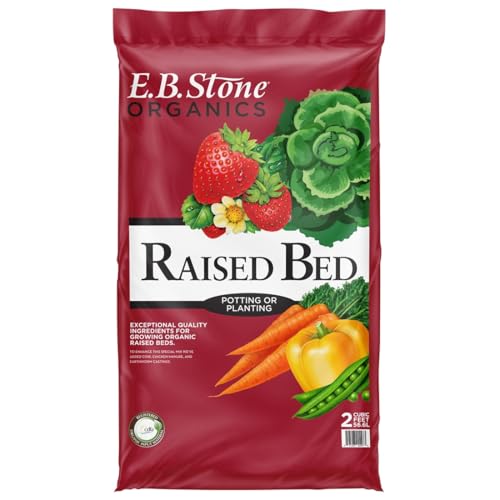
Best for gardeners seeking organic, nutrient-rich soil. This 2-cubic-foot mix emphasizes premium organic ingredients, including compost, coir, pumice, and earthworm castings, plus mycorrhizae to support a living soil environment. It’s well-suited for raised beds and large containers for vegetables, herbs, and flowers. Choose this if you prefer a ready-to-use organic blend that emphasizes soil biology and moisture retention without synthetic fillers.
- Best for organic raised beds and containers.
- Better for soil biology and long-term fertility.
- Limitation: may cost more than non-organic blends.
Burpee Premium Organic Potting Mix

Best for container gardeners and raised beds who need an all-natural mix with a built-in feeding cycle. This OMRI-listed blend includes coconut coir for moisture retention and plant food to nourish roots early on, followed by a slow-release feeding for up to three months. It’s ideal for beginners and those who plant in pots or small raised beds where compact moisture management matters. Consider this if you want an organic option with long-lasting nutrition in one bag.
- Best for containers and mixed raised beds.
- Better for immediate feeding and sustained moisture control.
- Limitation: coconut coir can be prone to compacting if overwatered in very dense pots.
Michigan Peat Garden Magic 40 lb Bag

Best for all-purpose outdoor and indoor planting needs. This 40-pound bag provides moisture retention with a peat-based blend and sand, designed for general planting and raised beds. It’s a versatile option for gardeners who want a reliable mix for a variety of plants, including lawns, beds, and containers. Choose this if you want a traditional, widely compatible soil mix that supports diverse plantings with balanced drainage.
- Best for broad, all-purpose use.
- Better for versatile projects beyond raised beds.
- Limitation: peat content may be less ideal for extremely hot or drought-prone areas without supplemental irrigation.
Verdana Coco Coir Potting Soil Brick

Best for seed starting, raised beds, and houseplants. This 10-pound brick expands to about 72 quarts, offering a high-yield, peat-moss-free alternative. Coco coir is renewable and helps with drainage while retaining adequate moisture. Choose this if you want a peat-free option that scales easily for large beds or starter flats, though expansion requires careful hydration to avoid clumping.
- Best for peat-free and scalable mixes.
- Better for seed starting and eco-friendly projects.
- Limitation: requires proper hydration to avoid dust and clumps when expanding.
Buying Guide
What should you consider when selecting potting mix for raised beds?
- Ingredients and organic content: Do you prefer organic ingredients (mycorrhizae, earthworm castings) or a more neutral mix? Organic blends support soil biology but can be pricier.
- Moisture retention vs drainage: Look for blends that balance moisture with drainage to prevent root rot in warm climates and dehydration in hot summers.
- Intended use: Raised beds vs containers; some blends are designed specifically for raised beds with larger particle sizes for root growth.
- Soil biology: Some mixes include mycorrhizae and beneficial microbes; these can support better nutrient uptake and plant health over time.
- Certification and safety: If you garden for food, OMRI listing or other organic certifications can guide your choice.
Practical comparison considerations
- Best for quick setup: FoxFarm Raised Bed Planting Mix is ready-to-use with minimal prep.
- Best organic soil biology: E.B. Stone Organics mix emphasizes living soil health.
- Best budget-friendly all-purpose: Garden Magic blends offer versatility across indoor and outdoor projects.
- Best peat-free option: Verdana Coco Coir Brick reduces peat reliance and expands to a large volume.
Usage tips
- Mix with existing soil in established beds if you want to refresh fertility and texture.
- Test for drainage by watering and observing how quickly water drains from a small test area.
- Avoid over-saturation; ensure beds have sufficient drainage to prevent root rot.
FAQ
Is potting mix the same as soil?
Potting mix is a soilless or lightweight blend designed for containers and raised beds, while soil refers to the natural ground material. Potting mixes often use coco coir, peat, or compost as bases and are optimized for drainage and aeration.
Do raised beds require a special mix?
Raised beds benefit from blends that drain well, retain moisture, and provide nutrients. Many ready-to-use mixes are formulated specifically for raised beds and containers.
Can I reuse potting mix from last season?
Yes, but for best results consider refreshing with compost or a new blend to restore nutrients and improve soil structure.
What’s the advantage of organic potting mixes?
Organic blends support beneficial soil life, reduce synthetic inputs, and align with organic gardening goals, though they may require more careful nutrient management.
How much should I fill in raised beds?
Fill beds to an appropriate depth for your crop; most vegetables need 6–12 inches of soil depth for healthy root development.