The best soil mix for orchids balances drainage, aeration, and moisture retention to mimic their natural epiphytic habitat. This guide highlights five top options that suit a range of orchid types, from Phalaenopsis to Cattleya, Dendrobium, and beyond. Whether you’re repotting a mature orchid or starting a new plant, these mixes are chosen for reliability, consistency, and suitability for American indoor growing. The buyer profiles below show who each mix is best for and why it stands out.
Summary of selected products:
| Product | Best For | Why It Stands Out | Size |
|---|---|---|---|
| Better-Gro Special Orchid Mix – 4 Quarts | General orchid care, small repots | Balanced blend of fir bark, charcoal, sponge rock, perlite for drainage and air flow | 4 qt |
| Better-Gro Special Orchid Mix – 8 Quarts | Enthusiasts with multiple plants or larger repots | Versatile, American Orchid Society-endorsed versatility, strong drainage | 8 qt |
| [Upgraded] Duspro Orchid Potting Mix (1 QRT) | Best for diverse epiphytic orchids | Upgraded formula with pumice, pine bark, moss, chunky perlite for aeration and longevity | 1 qt |
| [Upgraded] Duspro Orchid Potting Mix (2 QT) | Medium sized repots and ongoing orchid care | Same premium blend with enhanced drainage and structure | 2 qt |
| Rosy Soil Orchid Soil Potting Mix (4 Quarts) | Eco-conscious growers and beginners | Peat-free, microbially active biochar soil for superior aeration | 4 qt |
Better-Gro Special Orchid Mix — 4 Quarts

Best for small-to-medium orchid repots and beginners who want a ready-to-use mix. This dynamic blend uses western fir bark, hardwood charcoal, sponge rock, coarse perlite, and bark nuggets to encourage robust root growth and healthy drainage. The formula aims to replicate the orchid’s natural habitat with space for air movement around roots. Best for Phalaenopsis, Cattleya, and Dendrobium varieties that benefit from a well-drained, breathable medium. Caution: avoid overwatering, as even well-draining mixes can retain moisture if irrigation is excessive.
Better-Gro Special Orchid Mix — 8 Quarts
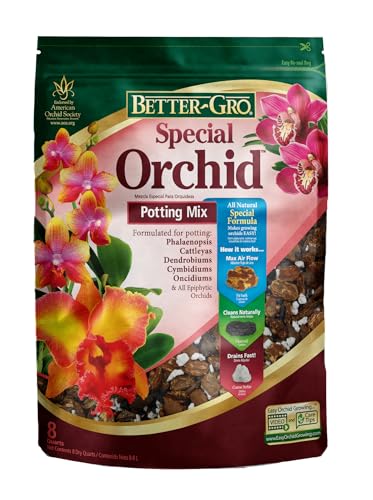
Better for orchid collections with multiple plants or larger repot needs. This larger bag mirrors the 4-quart mix but in a higher volume, offering consistent drainage and air flow suitable for Phalaenopsis, Cattleyas, and Dendrobiums. It’s a practical choice for hobbyists scaling up their orchid care. Limitation: larger bags may be heavier to handle and store in small spaces.
[Upgraded] Duspro Orchid Potting Mix — 1 QRT

Best for targeted repots of smaller orchids or for adding a compact, high-aeration medium to a mixed orchid setup. Duspro emphasizes a premium blend with forest moss, pine bark, pumice, and chunky perlite to create a stable, well-draining environment. Suitable for Phalaenopsis, Cattleya, Vanda, Miltonia, Dendrobium, and Cymbidium. Caution: ensure you distribute roots evenly to prevent substrate gaps that can dry out or overwater certain roots.
[Upgraded] Duspro Orchid Potting Mix — 2 QT

Better for mid-size repots and ongoing orchid care, this 2-quart version follows the same premium Duspro blend designed for optimal root growth and aeration. The formula’s pumice and pine bark components promote drainage while the moss provides moisture retention without soggy soil. Choose this if you have several medium orchids and want a balanced mix that’s easy to re-pot. Limitation: premium blends can be slightly pricier per quart than basic mixes.
Rosy Soil Orchid Soil Potting Mix — 4 Quarts

Best for eco-conscious growers seeking peat-free options. Rosy Soil Orchid Mix emphasizes a microbially active biochar-based formula for improved aeration and drainage, supporting a range of orchids from Phalaenopsis to Dendrobium. It’s a good fit for beginners who want a straightforward, peat-free medium with reliable root health. Caution: peat-free blends may require careful moisture management to avoid quick drying in dry indoor air.
Buying Guide: How To Choose The Right Orchid Potting Mix
- Orchid type and growth habit: Epiphytic orchids (Phalaenopsis, Cattleya, Dendrobium) prefer airy media with good drainage. Leafy, compact roots benefit from bark-based mixes. Ground-dwelling or terrestrial species may tolerate different textures.
- Drainage vs. moisture retention: If your climate is humid or your orchids are prone to root rot, favor mixes with more air spaces (bark, perlite, pumice). In very dry environments, small amounts of moisture-retentive components can help keep roots hydrated between waterings.
- Ingredient quality and consistency: Check for uniform particle sizes and well-blended components. Breaks in texture or inconsistent sizing can create pockets that retain too much water or fail to drain.
- Size and storage: Larger bags offer cost efficiency but require more storage space and heavier handling. Smaller bags suit beginners or trial runs.
- Care and maintenance: Some mixes include moss or biochar that influence moisture retention and microbial activity. Consider your watering routine and plant care schedule when choosing.
Frequently Asked Questions
- What is the best orchid mix for Phalaenopsis? A well-draining bark-based mix with some perlite or pumice works well, supporting airflow and quick drainage while preventing waterlogged roots.
- How often should I repot orchids? Most healthy orchids benefit from repotting every 1-2 years, depending on root growth and mix breakdown. Aromatic or dense mixes may need more frequent refresh.
- Can I mix orchid substrates at home? Yes. A common approach is to blend bark, perlite, and pumice with a small amount of moss to improve moisture retention without sacrificing drainage.
- Is peat-free better for orchids? Peat-free mixes are eco-friendlier and often provide good drainage. However, always match the mix texture to the orchid’s species and your environment.
- What signs indicate a poor mix? Waterlogged roots, yellowing leaves, and slow growth suggest poor drainage or compaction. Consider switching to a coarser mix or repotting with fresh medium.