Farmers increasingly rely on solar panels to power irrigation, lighting, electric fences, and remote monitoring systems. This guide highlights five strong options that balance efficiency, durability, and portability for farm settings. Each entry includes key features and practical notes to help you compare capabilities for field reliability, weather resistance, and long-term cost savings.
| Product | Brand | Key Strength | Amazon Link |
|---|---|---|---|
| Renogy 400W Portable Solar Panel Blanket | Renogy | High efficiency foldable, compact storage | See product below |
| Callsun 400W Solar Panel (4 x 100W) | Callsun | True 100W per panel, rugged build | See product below |
| DOKIO 400W Mono Solar Panel | DOKIO | Longer built-in MC4 leads, versatile wiring | See product below |
| JJN Bifacial 400W Solar Panel | JJN | Bifacial design, high efficiency | See product below |
| EF ECOFLOW 220W Portable Solar Panel | EF ECOFLOW | High 25% efficiency, foldable | See product below |
Note: This article presents objective specifications and practical considerations for farm use. Prices are not listed, and links direct to Amazon product pages for quick reference.
Renogy 400W Portable Solar Panel Blanket
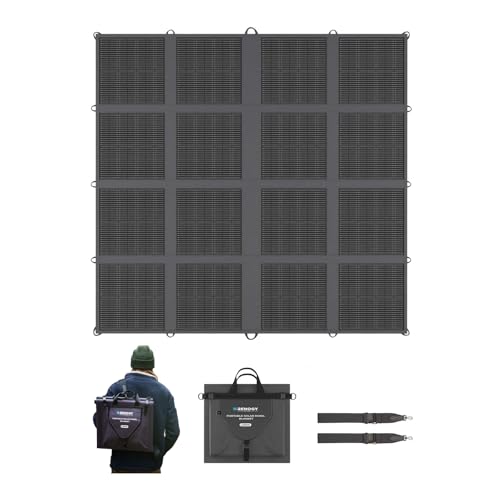
The Renogy 400W Portable Solar Panel Blanket is a foldable, lightweight option designed for off-grid farming tasks where space is limited. Weighing about 16.09 pounds, this panel packs into a compact, backpack-sized form and stores with ease in equipment sheds or vehicle interiors. Its 16-fold design enables flexible deployment on vehicles, trailers, or ground setups, supporting rapid reconfiguration for grazing rotations or field maintenance.
Key features include 25% efficiency using 16BB N-Type cells, which translates to more energy collected from the same sunlight compared with conventional 9BB designs. The panel supports multiple installation methods—lay across a truck bed, hang between racks, or lay on the ground—without sacrificing full 400W output. This makes it a practical option for farmers who need dependable power for irrigation pumps, battery backups, or cold storage reductions during outages.
For farm settings, the panel’s durability is reinforced by rugged construction and reliable performance in variable weather. It is suitable for RVs, trailers, and utility off-grid setups, providing a consistent power source in remote fields and during emergency outages. The lightweight build also improves transportability to remote plots, lease lands, or temporary equipment stations.
Callsun 400W Solar Panel (4 Pcs)

The Callsun 400W panel bundle consists of four monocrystalline 100W modules designed for high-output reliability. The true 100W performance of each panel ensures that field equipment, irrigation controllers, and small baseload power stations meet demand with measurable headroom for cloudy days. Its rugged construction includes low-iron tempered glass and a corrosion-resistant aluminum frame, delivering IP67 waterproof protection for farm environments where exposure to rain, dust, and snow is common.
Farmers can deploy these panels in arrays on rooftops of sheds, portable frames, or fences to harvest solar energy across larger plots. The four-panel setup provides flexibility—expandable as farm energy needs grow or to power multiple devices concurrently. The panels’ efficiency often yields more usable energy per square foot, a practical advantage when limited installation space exists on ranches or smallholdings.
While designed for durability, the bundle is still important to monitor for optimal tilt and shading. The panels perform best under direct sun during peak daylight hours, and the multiple modules allow easier maintenance by swapping a single unit if needed without taking down an entire array.
DOKIO 400W Mono Solar Panel

The DOKIO 400W mono solar panel targets off-grid farming setups that require robust MPPT-enabled charging and flexible wiring. The panel’s 400W lab rating translates to real-world outputs dependent on sun exposure, temperature, and wiring. It ships with 3-meter MC4 leads, extending reach to controllers and storage units such as battery banks, charge controllers, or portable power stations—handy for farm sheds or remote barns.
One notable feature is its emphasis on wiring flexibility for 12V systems. For rural installations where long distances exist between panels and storage, the longer leads reduce the number of connectors and potential points of failure. Parallel wiring is often preferred for smoother charging, particularly when multiple panels are used to supply a single battery bank. This makes DOKIO a practical choice for expanding farm energy solutions over time.
Durability and weather resistance are also addressed with quality materials and protective design, enabling operation across variable weather patterns without frequent maintenance. Proper sizing and mounting ensure stable performance during wind and precipitation common in agricultural parcels.
JJN Bifacial 400W Solar Panel

The JJN bifacial 400W solar panel uses N-Type 16BB cells and a bifacial design to generate electricity from both sides. This yields up to 25% higher efficiency in favorable conditions, which can be advantageous for farm installations where light refl ects off snow or light-colored soil. The front and back sides capture more energy, particularly in field edges or reflective surfaces around equipment yards.
Constructed with a black corrosion-resistant aluminum frame, these panels withstand high wind loads (up to 2400Pa) and snow loads (5400Pa), making them suitable for harsh farming environments. The IP65 IP67-rated junction box and connectors provide reliable protection against moisture, ensuring long-term performance in outdoor settings. This makes them a compelling option for rooftop, ground-mount, or portable farm applications where efficiency and durability matter.
For farm operators evaluating power reliability, bifacial panels can be particularly beneficial in partially shaded areas or fields with varied surface textures. However, installation requires careful planning to maximize the back-side capture and to maintain the panel’s orientation to sun angles during different seasons.
EF ECOFLOW 220W Portable Solar Panel

The EF ECOFLOW 220W portable solar panel uses N-Type cells to achieve up to 25% efficiency, with a compact foldable design for field deployments. A 30-60° adjustable angle bracket helps optimize sun exposure across different times of day and seasons, a practical feature for farm locations with variable sun angles due to terrain or shading structures. The panel’s lightweight and robust construction makes it a convenient option for mobile field power or emergency backup during outages.
Durability is reinforced by ETFE coating, providing weather resistance against rain, dust, and UV exposure. The foldable form factor simplifies transport to remote plots, trailers, or greenhouses. While it may be smaller in wattage compared to multi-panel farm arrays, its portability makes it suitable for quick power boosts, charging small to mid-size power stations, or supplementing larger solar arrays on demand.
Buying Guide for Farm-Grade Solar Panels
Key considerations when choosing solar panels for farming include total energy needs, space, and climate. Farms often require a mix of durability, efficiency, and ease of maintenance to ensure reliability across seasons. Below are factors to weigh and how they apply to the models above.
- Wattage and scale: For larger farm operations, consider panels with higher wattage per unit and modularity to scale without overcomplicating wiring. Four 100W modules, as in the Callsun bundle, can form a scalable array, while 400W panels offer substantial energy in one module.
- Efficiency: Higher efficiency panels produce more energy per square foot—important when space is limited on farm rooftops or in livestock yards. 16BB N-Type cells often outperform standard setups, enhancing daily output under similar sun conditions.
- Durability and weather resistance: Farms face wind, rain, dust, and temperature swings. Panels with robust frames, IP ratings, and ETFE or tempered glass coatings provide longer service life with less maintenance.
- Portability vs. fixed installs: Portable or foldable panels are ideal for temporary setups, irrigation pumps, or events on the farm. Fixed rooftop or ground-mounted arrays suit ongoing power needs for barns, milking stations, or greenhouses.
- Wiring and integration: Look for panels with longer MC4 leads and compatibility with common controllers and battery banks. Parallel wiring is often favored for smoother charging when multiple panels feed a single storage system.
- Maintenance and accessibility: Choose panels that are easy to inspect, clean, and replace. Bifacial designs can offer higher efficiency but require proper siting for maximum back-side capture.
- Cost-to-benefit: While prices are not listed here, evaluate long-term return on investment, including durability, warranty terms, and expected lifespan under farm conditions.
Farmers should match panel choice to the specific tasks at hand—irrigation pumps, cold storage, fence energizers, or farm office power—and consider combining portable panels for field tasks with larger fixed arrays at barns or sheds to ensure resilience during outages or peak demand periods.