Answering the question, this guide highlights practical solar power options for sheds, including lighting, ventilation, and small electronics. Each product is chosen for different shed needs: entry-level kits for power basics, higher-capacity kits for larger off-grid setups, and efficient solar-powered fans and lights for comfort and safety. This collection helps buyers decide who benefits most from each option—from weekend hobbyists to remote shed operators. The table below summarizes five strong choices and what they’re best for.
| Product | ||
|---|---|---|
| ExpertPower 100W Kit | Small sheds, hands-on projects | All-in-one starter kit with panel, controller, and battery |
| ECO-WORTHY 200W Starter Kit | RV, cabins, larger off-grid sheds | Higher output with battery and inverter included |
| erifyng Solar Powered Fan | Ventilation for sheds and coops | No battery needed, direct solar power for airflow |
| HULPPRE Solar Shed Light | Indoors or outdoors lighting | Pull-string operation with dual charging |
| Latband Solar Shed Light | Motion-activated shed lighting | Five lighting modes and remote control |
ExpertPower 100W Solar Power Kit

The ExpertPower kit includes a 100W monocrystalline panel, a 10A PWM charge controller, a 12V 21Ah gel deep-cycle battery, cables, and mounting hardware. This setup suits a small garden shed that needs dependable, off-grid power for lighting, small tools, and USB devices. Best for compact spaces where a simple, reliable power source is needed. One limitation is that the included battery capacity may limit longer high-power runs on cloudy days.
ECO-WORTHY 200W Complete Solar Panel Starter Kit

The ECO-WORTHY kit provides a complete off-grid setup with a 200W solar panel, a 30A charge controller, a 50Ah LiFePO4 battery, and an inverter. This package is better for medium sheds or cabins that require more appliances, tools, or charging capability. Choose this if you expect higher daytime usage or plan to run inverters for longer periods. Note that LiFePO4 batteries bring weight and cost considerations, especially for single-person installations.
erifyng Solar Powered Fan

This solar-powered fan is designed for sheds, greenhouses, and chicken coops. It uses a solar panel to generate airflow directly, with IPX7 weatherproofing and an aluminum housing for durability. Best for improving ventilation without wiring, and better for smaller sheds reliant on daytime solar. A potential limitation is no built-in battery, so airflow depends on sun exposure and panel size.
HULPPRE Solar Shed Light

This light uses a pull-string control and supports solar or USB-C charging for continuous operation. It is suitable for indoor or outdoor shed lighting during power outages or off-grid use. Best for users who want simple operation and flexible charging options. The pull-string design may be less convenient for some installations where hands-free control is preferred.
Latband Solar Shed Light With Motion
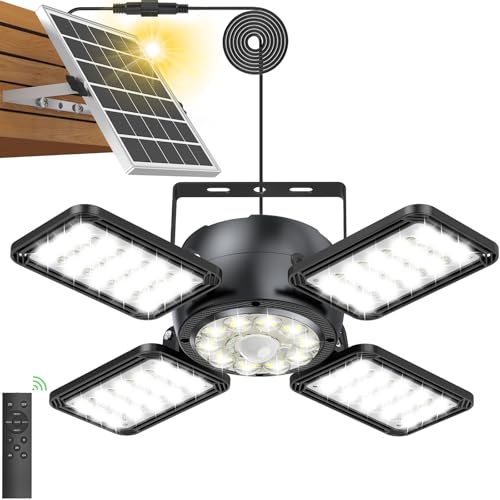
Latband offers a 1200-lumen, 174-LED solar light with five modes and remote control. It includes motion sensing for automatic activation and multiple timers, making it efficient for barns, sheds, and workspaces. Best for hands-off operation with customizable lighting schedules. A limit to consider is the reliance on stored battery power for night use and the need for sun exposure to maintain brightness.
Buying Guide: Key Considerations For Solar Shed Power
- Power needs: List essential devices (lights, fans, chargers) and estimate wattage to size panels and batteries appropriately.
- Location and sun exposure: Shaded or northern-facing sheds may require larger panels or higher-efficiency cells for reliable output.
- Battery type and capacity: Gel, LiFePO4, or AGM options affect weight, lifespan, and maintenance. Capacity should match daily usage and backup days.
- System type: Off-grid kits with inverters enable AC devices; direct DC devices save cost and complexity.
- Installation complexity: Some kits include mounting hardware and cables; others require custom mounting and wiring skills.
- Weather durability: Look for IP ratings, corrosion-resistant frames, and sealed enclosures for shed environments.
- Expandability: If you anticipate growth, choose modular systems or kits that can add panels, batteries, or inverters later.
Practical How-To And Setup Tips
- Position the solar panel to maximize sun exposure, typically facing true south in the continental United States.
- Lock batteries on a dry, ventilated shelf away from direct heat sources and moisture.
- Keep connections clean and avoid over-tightening MC4 or battery cables to prevent damage.
- Use a basic electrical diagram to map panel, controller, battery, and load wiring for future troubleshooting.
FAQ: Quick Answers For Solar Shed Buyers
- Q: Do I need an inverter for shed power?
- A: If you need AC appliances, yes; for DC devices, you can run directly off the battery.
- Q: How big should a shed solar kit be?
- A: Size it to cover your daily watt-hour use plus a buffer for cloudy days.
- Q: Can solar power run a freezer in a shed?
- A: A small, efficient freezer may be possible with a larger battery bank and adequate panel capacity.
- Q: Is LiFePO4 better than Gel batteries?
- A: LiFePO4 offers longer life and deeper discharge but costs more upfront; Gel is lower cost and maintenance-free.
- Q: Will I need special permits?
- A: Generally not for personal shed setups, but check local regulations and HOA rules if applicable.