Answering the question “what temperature sensor should I use for a greenhouse?” with practical, product-backed guidance. This guide highlights five reliable options that suit different setups—from WiFi-connected monitors to long-range LoRa sensors. Each pick targets greenhouse conditions, helping you maintain optimal temperature and humidity for plant health. Ideal for growers, hobbyists, and small farms seeking real-time alerts and data logging.
Overview of top picks. The table summarizes who each product is best for and a key strength to help you compare quickly.
| Product | Best For | Strength |
|---|---|---|
| Govee Smart Thermometer Hygrometer | Smart greenhouse with WiFi alerts | Real-time app alerts, 2-year data storage |
| TempPro Hygrometer Thermometer (B0CQLD3TXR) | Bluetooth, long-range monitoring | 2-year data export |
| U UNNI Indoor Outdoor Thermometer | Multi-location monitoring | 330 ft range, backlit display |
| TempPro TP60 Wireless Indoor Outdoor | Large space setups | 500 ft range, no hub/app required |
| Antonki 2 Pack Room Thermometer | Budget dual-pack for multiple rooms | Two sensors per pack |
Govee Smart Thermometer Hygrometer

The Govee model provides real-time temperature and humidity data via WiFi and Bluetooth through the Govee Home app. It excels for growers who want mobile alerts and remote monitoring in a greenhouse or incubator. The sensor uses a Swiss-made component for accuracy, with temperature precision around ±0.54°F (±0.3°C) and humidity around ±3% RH. It refreshes data every 2 seconds and supports a widget for quick viewing. Best for: greenhouse managers who prefer app-based alerts and remote access. Limitation: does not support 5G WiFi, so ensure your router’s 2.4 GHz band is available.
Why selected: This option balances precise readings, fast updates, and practical app alerts, making it well-suited for continuous greenhouse supervision. It also offers two-year data storage export, useful for trend analysis and planning.
TempPro Hygrometer Thermometer, Bluetooth

This TempPro model leverages Bluetooth for direct, long-range monitoring up to 260 feet, ideal for sheds or larger greenhouses where WiFi reach may be spotty. It offers a 2-year data storage and export function, enabling historical analysis to plan irrigation and ventilation. It uses an NTC sensor for high accuracy (±0.9°F and ±2% RH) and updates every 10 seconds. Best for: growers who want offline, local monitoring with optional historical exports. Limitation: requires Bluetooth connection and the associated app, with privacy noted in setup.
U UNNI Indoor Outdoor Thermometer
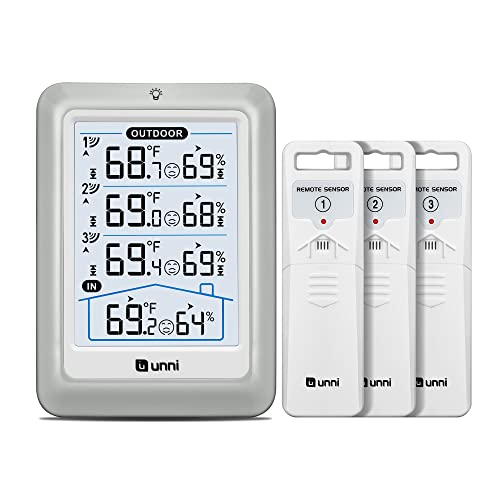
The UNNI device covers indoor and outdoor measurements with a 330-foot range and a backlit display for easy readings in dimly lit greenhouses or barns. It provides three sensors’ data and switches between °C and °F. Temperature range spans from -40°F to 158°F with humidity from 20% to 95%. Best for: users needing broad coverage across indoor and outdoor zones within a single system. Caution: demonstrated accuracy is ±1.8°F and ±5% RH, which is adequate for general monitoring but less precise than laboratory-grade sensors.
TempPro Bluetooth Thermometer Hygrometer (TP351)

This TempPro TP351 provides easy Bluetooth connection with a 260-foot remote range and a 2-year data logging export. It emphasizes a user-friendly setup (no registration required) and a precise sensor package with ±0.5°F and ±2% RH accuracy. Best for: gardeners who want straightforward smartphone setup and reliable long-range Bluetooth monitoring. Limitation: relies on Bluetooth proximity to the phone; not ideal for large, multi-room greenhouse spaces without a connected hub.
TempPro TP60 Wireless Indoor Outdoor

The TP60 model offers a generous 500-foot wireless range, enabling monitoring across large greenhouse layouts without a hub. It records maximum and minimum readings and includes a large display for quick checks. Best for: setups that require long-range sensing in open or semi-enclosed spaces. Limitation: requires battery power (AAA) and may need periodic battery changes to maintain continuous monitoring.
Antonki 2 Pack Room Thermometer

Antonki’s 2-pack provides two independent sensors with a large LCD display and CR2032 batteries included. Temperature range spans -58 to 158°F with humidity from 10% to 99%. Each sensor has separate readings for improved accuracy and faster stabilization. Best for: budget-conscious growers who want multi-room coverage and easy battery-powered operation. Caution: readings can fluctuate during initial activation as sensors stabilize, typically within a few minutes.
Buying Guide: Key Considerations For Greenhouse Monitoring
- Connectivity: Choose between WiFi, Bluetooth, or LoRa (long-range) based on greenhouse size and network availability. WiFi is convenient for remote access; Bluetooth is simple for local use; LoRa suits distant or multi-zone setups.
- Temperature and humidity accuracy: Look for sensors with stated tolerances (e.g., ±0.3–±2% RH). Higher accuracy improves irrigation and ventilation timing.
- Data logging and export: If you need long-term climate trend analysis, select models with built-in data storage and export options (2-year or more).
- Range and coverage: For large greenhouses, prioritize longer wireless ranges (up to 500 ft or more) or multi-sensor packs to cover different zones.
- Display and alerts: A backlit display helps in low-light conditions; audible and app-based alerts are crucial for rapid response to changes.
- Power and maintenance: Battery-powered sensors offer flexibility but require battery management; wired or USB-powered options reduce maintenance.
Frequently Asked Questions
- What is the most accurate greenhouse temperature sensor? A sensor with explicit tolerances like ±0.3–±2% RH and recurring, fast refresh (every 2–10 seconds) is typically most accurate for greenhouse control.
- Do I need a hub for these sensors? Some require a hub (e.g., LoRa systems) while others work directly via WiFi or Bluetooth. Choose based on your network and space layout.
- Is data export important for greenhouse management? Yes, exporting data over 2 years helps identify seasonal patterns and optimize watering and ventilation.
- Can I monitor multiple zones with one device? Several products support multi-sensor packs or long-range transmission, enabling coverage across greenhouses, sheds, or multiple rooms.
- What should I consider for outdoor greenhouse use? Look for sensors with robust outdoor-rated housing and a wide indoor/outdoor temperature range, plus a long-range communication method.
- Are Bluetooth sensors suitable for large greenhouses? Bluetooth works well for small spaces or single-room setups; for larger areas, WiFi, LoRa, or extended-range Bluetooth beacons are better choices.