Answering your need for fast, reliable water quality checks, this guide compares top testing strips kits for home and small-scope use. Ideal for homeowners, renters, pool owners, and anyone safeguarding drinking water, these kits cover common contaminants and water qualities. Each product section notes who it’s best for and why it was chosen, with clear pros, limitations, and practical tips.
| Product | Best For | Key Benefit | Notes |
|---|---|---|---|
| All-New 20 in 1 Drinking Water Testing Kit | Bands of households needing broad coverage | Comprehensive 20-parameter testing | Clear ranges; easy strip reading |
| EASYTEST 7-Way Pool Test Strips | Pool and hot tub owners | 7 parameters in one test | Twice-weekly testing suggested |
| Varify 17in1 Drinking Water Test Kit | Well, city, and general home water users | 17 parameters + bacteria options | Color-coded results |
| Umlecoa 16 in 1 Premium Water Test Kit | Families needing quick multi-parameter checks | 16-in-1 coverage | 3-step quick testing |
| TESPERT 16 in 1 Drinking Water Test Strips | General home testers on a budget | 16-parameter initial screening | 30-second results window |
All-New 20 in 1 Drinking Water Testing Kit

The kit performs 20-parameter testing for drinking water, including hardness, lead, iron, copper, chlorine, and fluoride. It provides a clear results guide attached to the bottle and an easy-to-read color chart on strips, supporting quick interpretation. Best for households needing broad screening across many contaminants in taps, wells, and home water systems.
Best for: Homeowners who want a single kit covering multiple common contaminants. Better for those who value straightforward reading guides directly on the bottle.
Caution: While broad, it may not substitute professional lab testing for certain regulatory or highly sensitive analyses in some settings.
EASYTEST 7-Way Pool Test Strips
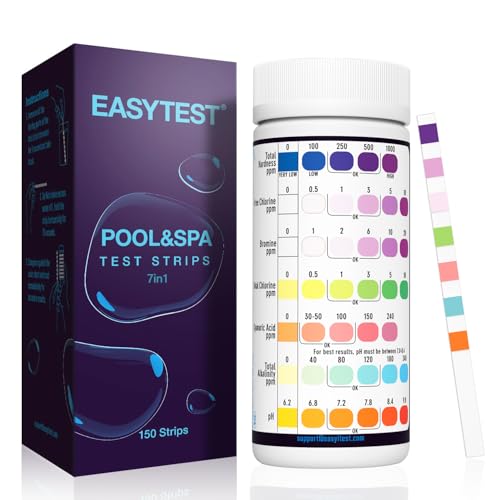
This kit tests seven pool-related parameters, including bromine, total alkalinity, pH, free chlorine, total hardness, cyanuric acid, and total chlorine. It offers fast results by dipping, waiting briefly, and comparing to a color chart. Best for pool or spa owners who need quick, reliable checks to maintain pool safety and clarity.
Best for: Pool or hot tub owners who want a compact, affordable, multi-parameter option. Better for routine maintenance rather than exhaustive drinking-water analysis.
Caution: Designed for pool water; results may not fully reflect drinking-water quality.
Varify 17in1 Complete Drinking Water Test Kit

Varify’s kit delivers 17 essential parameters, including chlorine, fluoride, lead, iron, bacteria, and more. It emphasizes professional-grade quality with a user-friendly, color-coded system for quick interpretation. This kit provides a broad, holistic view of water safety for well, tap, or city water supplies.
Best for: Home users who want a thorough, multi-parameter check with easy color interpretation. Choose this if you need a broad range of indicators in one kit.
Caution: The kit includes bacteria testing components; ensure proper handling and interpretation according to the guide.
Umlecoa 16 in 1 Premium Water Test Kit

Umlecoa’s kit covers 16 parameters, including pH, hardness, chlorine, lead, iron, copper, nitrate, nitrite, and more. It emphasizes fast results in about 3 steps and supports testing across drinking water, pools, spas, ponds, and more. Best for families seeking a quick, practical overview of general water quality.
Best for: General home testing with broad coverage and simple steps. The three-step process makes it accessible for first-time testers.
Caution: Some users may require additional tests for regulatory compliance in specific applications.
TESPERT Drinking Water Test Strips 125 Ct 16 in 1

TESPERT provides 16-parameter screening with results in about 30 seconds. The kit uses simple immersion reading and encourages daylight or 6500K lighting for better color accuracy. It’s designed for quick checks at home, well, tap, and city water. Useful for initial screening and deciding if further testing is needed.
Best for: Quick, budget-friendly screening for everyday home use. Choose this if you want rapid results with a simple test flow.
Caution: Color interpretation can vary with lighting and timing; follow the guidance to avoid misreading.
Buying Guide
- Number of parameters — If you need broad coverage, choose multi-parameter kits (16–20 tests). For simple checks, a 7-parameter kit may suffice.
- Parameter relevance — Prioritize lead, chlorine, pH, hardness, and fluoride for drinking water; add bacteria or nitrate testing if you suspect contamination.
- Ease of use — Look for color-coded charts, clear bottles with onboard guides, and straightforward dipping and reading steps to minimize user error.
- Water source compatibility — Confirm whether the kit supports your water type (tap, well, city, pool, spa) and whether it includes bacteria or heavy-metal tests if needed.
- Result interpretation — Prefer kits with explicit ranges and color charts that reduce ambiguity. Some kits provide separate guidance for when to seek professional testing.
- Accuracy and repeatability — Consider kits with premium-grade strips or validated color charts. More strips per pack can reduce cost per test for frequent testing.
- Safety and handling — Some kits include bacteria testing components; handle safely and follow disposal instructions for used strips.
Frequently Asked Questions
- Why should I test my drinking water at home? Home testing helps identify contaminants that could affect health and informs whether professional testing is needed.
- What is the best all-in-one kit for a typical household? Kits with around 16–20 parameters provide broad screening and are convenient for regular checks.
- How often should I test pool water? For pools and spas, testing twice per week is commonly recommended to maintain sanitizer levels and safety.
- Can I rely on color charts alone for accurate results? Color charts are designed for quick interpretation, but for critical decisions or regulatory compliance, confirm results with a lab or more precise instrumentation.
- Do these kits test for bacteria? Some kits include bacteria testing options; otherwise, separate lab testing may be required for definitive bacterial assessment.
- What should I do if a test shows unsafe levels? Follow the kit’s guidance, seek professional testing if needed, and take actions such as using a filtration system or adjusting treatment, depending on the contaminant.