Answering your search for an easy, reliable garden watering solution, this guide highlights top programmable hose timers ideal for yards, lawns, and planters. The featured products are best for different setups—from basic sprinklers to drip irrigation systems and busy households. Use the buying table below to compare quick specs and choose the right timer for your needs.
| Product | Best For | Key Benefit |
|---|---|---|
| RAINPOINT Sprinkler Timer | General garden watering, one-outlet setups | Large LCD, flexible scheduling |
| Orbit Programmable Digital Timer (62061) | Digital ease with rain delay | Clear LCD, reliable scheduling |
| Sprobil Sprinkler Timer | Versatile outdoor uses | Anti-twist design, IP55 rating |
| Ortıs Sprinkler Timer | All-season, leak-resilient systems | Full-view LCD, three modes |
| Insoma Water Timer | Durable, precise irrigation | Brass inlet, multiple modes |
RAINPOINT Sprinkler Timer

The RAINPOINT timer supports Start Time, Watering Duration from 1 minute to 3 hours 59 minutes, and Watering Frequency from 1 hour up to 12 hours or 1 day to 7 days. This makes it suitable for households that want precise, customizable irrigation without daily adjustments. It includes rain delay (24/48/72 hours) and a manual mode for immediate watering without disrupting the predetermined schedule. The large LCD screen displays watering time, frequency, and power, aiding quick setup and ongoing monitoring. Best for homeowners who want a straightforward, visible control panel with flexible pacing for lawns and small gardens.
Caution: Ensure your faucet and garden hose connections are secure and check the rain delay when extended breaks are expected. Data indicates a strong fit for basic, one-outlet irrigation needs, but users with multiple zones may need additional timers or a zoning controller.
Orbit Programmable Digital Hose Timer (62061)

This Orbit model converts a faucet into an automatic watering system with a reliable single outlet and a clear LCD for easy programming. It emphasizes water-saving irrigation through a consistent schedule and adjustable duration, ideal for lawns, gardens, and landscapes seeking efficient water use. The explicit digital controls simplify setup, enabling precise watering without guesswork. Best for budget-conscious homeowners who want a straightforward, digital timer with clear feedback on settings.
Limitation to note: It is a single-outlet timer, so multi-zone irrigation requires additional timers or controllers. Best used where only one hose needs timed watering at a time.
Orbit Mechanical Water Timer (62034)

The Orbit Mechanical Water Timer uses a clockwork, battery-free design with an oversized dial for smooth, wet-hand adjustments. It’s ideal where electronic timers are undesirable or unreliable due to power issues or budget constraints. Best for traditionalists who want dependable, mechanical irrigation control with simple rollback capability. It’s particularly suited for gardeners who prefer hands-on, mechanical reliability rather than digital programming.
Limitation: No electronic display means scheduling flexibility is limited compared to digital timers. Less ideal for complex watering routines or frequent schedule changes.
Sprobil Sprinkler Timer
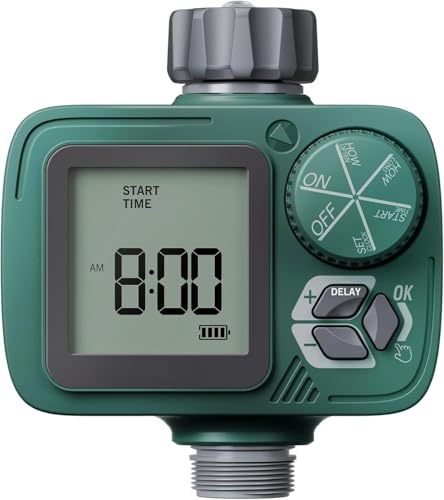
The Sprobil timer offers rain delay and manual modes, with comprehensive scheduling controls. It supports a flexible watering duration from 1 minute to 3 hours 59 minutes and a frequency setting between every 1-12 hours or 1-7 days. A large LCD screen helps users confirm timing details, making it a strong all-around choice for both lawns and potted plants. Best for those who want a robust, feature-rich timer with wide compatibility for various outdoor tasks.
Limitation: While feature-rich, it may be bulkier for compact setups. Ensure your hose layout has space for the unit’s footprint.
TiFFCOFiO Sprinkler Timer Outdoor

The TiFFCOFiO timer provides simple, knob-based programming and offers a rain delay of 24/48/72 hours with weatherproof design suitable for outdoor use. It’s a compact option for basic irrigation needs and is best for users who prefer a straightforward, manual-knob interface with built-in rain protection. Choose this if you want an uncomplicated timer that’s easy to set up and resistant to outdoor conditions.
Limitation: Lacks some advanced scheduling features found in digital models, such as long-term multi-day scheduling without manual recalibration.
Orbit One Outlet Single-Dial Timer (62056)

The Orbit One Outlet timer uses a single-dial program to automate watering, offering adjustable schedules and a large display for easy reading. It is well-suited for simple, routine irrigation tasks on smaller yards or planters. Best for homeowners seeking a budget-friendly, uncomplicated option with dependable basic control. Avoid this if you need multi-zone scheduling or smart features.
Ortis Hose Faucet Timer

The Ortis timer emphasizes three watering modes: Auto, Manual, and Rain Delay, with an IP67-rated, leak-proof design and a durable nylon-fiber composite main valve component. This makes it suitable for year-round use in varying climates. Best for households needing robust resistance to weather, with the ability to run automatic schedules while still providing manual control for quick tasks. Caution: The advanced build may be heavier and pricier than basic models.
Insoma Water Timer for Outdoor Garden
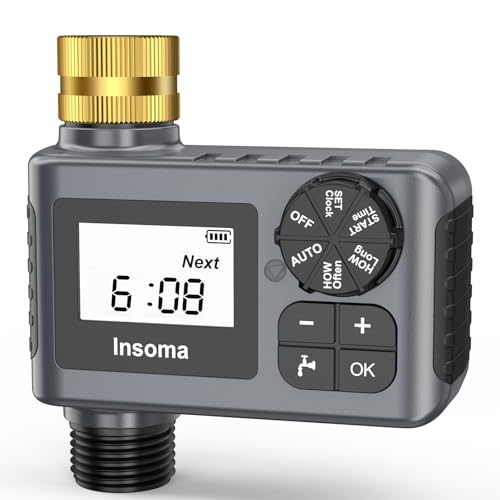
The Insoma timer features a 100% brass inlet, metal-threaded connection, and a built-in metal filter for sediment protection. It supports adjustable run times from 1 to 300 minutes and frequencies from every 6 to 7 days, plus a rain delay and manual mode. It’s best for gardeners prioritizing durability and reduced clog risk in hard water environments. Limitation: Brass inlets can be heavier and may require stronger hose connections in some setups.
Buying Guide
What should you consider when choosing a hose timer?
- Number of outlets: If you need to irrigate multiple zones, consider timers with multiple outlets or plan for multiple units.
- Programming type: Digital timers offer flexible schedules; mechanical timers rely on dial settings and are more durable but less feature-rich.
- Watering modes: Look for Rain Delay, Manual, and Auto modes to handle varying weather and plant needs.
- Durability and weather resistance: Materials (brass, nylon-fiber composites) and IP ratings influence longevity in sun, rain, and cold.
- Readability and ease of use: Large LCDs and straightforward controls reduce setup time and errors.
- Flow and compatibility: Confirm thread size (3/4-inch is standard) and pressure tolerance to prevent leaks.
Frequently Asked Questions
- What is rain delay on a hose timer?
– Rain delay pauses your programmed watering for a set number of hours or days to prevent overwatering after rainfall. - Can I use a timer for drip irrigation as well?
– Yes. Many timers support drip irrigation setups, but verify compatibility with drip components and flow rate. - Do mechanical timers require batteries?
– No. Mechanical timers operate without batteries but offer fewer scheduling options than digital models. - Is a higher price always better?
– Not always. Choose based on necessary features, durability, and whether you need multi-zone control or simple routines. - How do I prevent leaks at connections?
– Ensure proper-threaded fittings are tight, use Teflon tape where applicable, and inspect seals regularly for wear. - Should I choose digital or mechanical timers?
– Digital timers provide precise schedules and rain delays; mechanical timers excel in rugged environments with simpler needs.