Traveling sprinklers offer automated lawn irrigation by moving across your yard while spraying water. They’re ideal for larger lawns, gardens, or areas that need consistent coverage without constant manual adjustment. The top picks below are well-suited for American homeowners seeking efficient, hands-off watering for different lawn sizes and terrain. This guide highlights five reliable options and explains who each is best for.
| Product | Best For | Coverage |
|---|---|---|
| Nelson Rain Train 13,500 | Large lawns, long watering runs | Up to 13,500 sq. ft. |
| Orbit Traveling Tractor | Hands-off irrigation on varied turf | Wide lawn coverage |
| Melnor MiniMax Turbo 4000 | Smaller to mid-sized lawns | Up to 4,000 sq. ft. |
| Eden Weighted Essential | Even coverage on mid-size lawns | Up to 3,600 sq. ft. |
| Nelson RainTrain Sprinkler | Large yards needing uniform spray | Up to 13,500 sq. ft. |
Nelson Rain Train 13,500 Square Feet Cast Iron Outdoor Lawn Traveling Water Sprinkler

The Nelson Rain Train is designed for large properties and expansive irrigation runs. It moves along the lawn to cover up to 13,500 square feet, reducing manual adjustment. Best for homeowners with big yards who want consistent distribution across flat or gently sloped terrain. Its adjustable aluminum spray arms let you tailor coverage from 15 to 55 feet in diameter, shaping wet zones precisely. Choosing this model helps ensure even watering during dry periods and can reduce overall watering time compared to handheld methods.
Best for: large lawns, gardeners seeking customizable spray patterns, and users who value a durable cast-iron build with long-term outdoor resilience. Caution: heavy construction may be less ideal for very soft or newly seeded areas where movement could disturb tender soil.
Orbit Traveling Tractor Water Sprinkler

The Orbit Traveling Tractor offers automated irrigation with a self-propelled design that travels along the hose path. Its heavy-duty cast-iron body supports frequent outdoor use, making it suitable for homeowners who want a rugged, low-maintenance option. The model uses high-traction wheels to move steadily across lawns, ensuring stable coverage. Best for those who value hands-free operation and require a sturdy unit that can handle frequent running without frequent adjustments. Caution: movement depends on water pressure and hose setup, so ensure a steady supply to maintain consistent speed.
Melnor 65137AMZ MiniMax Turbo Oscillating Sprinkler

The Melnor MiniMax Turbo Oscillating Sprinkler packs full-size oscillation power into a compact form, covering up to 4,000 square feet. It includes 4-way adjustment to control width, range, and flow, plus a quick-connect bundle for easy setup. Best for mid-sized lawns needing targeted coverage with flexible configuration. It’s a practical choice where space is limited but a broad spray pattern is required. Limitation: despite its compact footprint, large lawns may require repositioning or additional units for complete coverage.
Eden Weighted Essential Oscillating Sprinkler
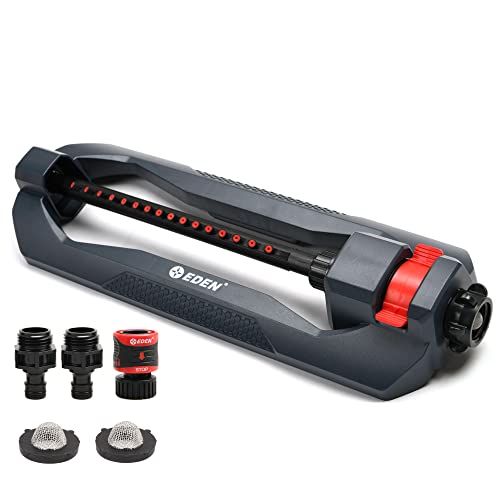
The Eden Weighted Essential Oscillating Sprinkler provides even coverage for lawns up to 3,600 square feet. It features 16 precision nozzles and adjustable range, enabling careful shaping of spray patterns to minimize water waste. The turbo drive motor delivers smooth operation and quieter performance, supporting longer use without overheating or jitter. Best for average-size lawns where uniform distribution across a defined area is important. Caution: the unit’s reach is best suited for mid-size lawns; very large yards may benefit from additional units.
Nelson RainTrain Sprinkler

The Nelson RainTrain Sprinkler is designed to cover up to 13,500 square feet with a rust-resistant, powder-coated cast-iron body. Adjustable spray arms let you tailor patterns from 15 to 55 feet in diameter, accommodating various garden layouts. Best for huge lawns where uniform, dependable irrigation is required. Its durable construction suits frequent outdoor use. Caution: heavier build may be less maneuverable on uneven ground or very soft soil, where stability could be affected.
Buying Guide
- Coverage needs: Measure your lawn to match sprinkler reach with your yard’s dimensions. Larger lawns benefit from models like the Nelson Rain Train or RainTrain Sprinkler with wide coverage.
- Terrain and soil: Heavy-duty cast-iron units excel on firm soil but can be less forgiving on soft or uneven ground. For uneven terrain, consider models with stable wheels and flexible spray arms.
- Power and speed: Self-propelled options simplify maintenance, but some models depend on water pressure and hose setup. Check speed options and confirm compatibility with your hose size.
- Adjustability: Look for adjustable spray width, range, and flow to minimize water waste and tailor watering to flower beds or borders.
- Durability and materials: Cast iron and brass fittings typically offer longevity, while lightweight plastics may be easier to reposition but less durable over time.
- Ease of setup: Quick-connect bundles and clear setup instructions reduce time before the first watering cycle.
FAQ
- Q: Which sprinkler is best for very large lawns?
A: Models with up to 13,500 sq. ft. coverage, like the Nelson Rain Train, are well-suited for expansive yards. - Q: Do these sprinklers require special hoses?
A: A standard garden hose with compatible fittings is typical; always verify hose diameter and connector type in the product specs. - Q: Are self-propelled sprinklers suitable for uneven ground?
A: They can be, but check wheel traction and weight distribution to ensure stable movement on slopes or soft soil. - Q: How do I avoid overwatering?
A: Use models with adjustable range and flow, water during cooler parts of the day, and place zones to minimize overlap. - Q: Do these units require batteries or electrical power?
A: Most traveling sprinklers operate from water pressure; some add-on components may require power, but the core units rely on water flow. - Q: Is it better to run multiple sprinklers or one large unit?
A: For very large or irregular lawns, multiple units can provide more uniform coverage and reduce gaps.