Looking for an ultrasonic fogger that helps maintain humidity and create a lush microclimate for plants indoors or in gardens? This guide highlights five suitable foggers that balance safety, reliability, and performance. Each option targets different buyer needs—from hobbyist terrariums to larger grow tents and water features. Best for beginners, best for large-scale fogging, and best for outdoor use are all covered to help you pick with confidence.
| Product | Brand | Best For |
|---|---|---|
| Mxmoonant 350ml/H Ultrasonic Mist Maker | Mxmoonant | Small water features, ponds, rockeries |
| Beendou 12 Head Ultrasonic Fogger | Beendou | Large outdoor or indoor spaces, long runtime |
| 19L Large DIY Humidifier Kit | CUMFYHOUS | DIY projects, grow tents, terrariums |
| YiMistnnts 6 Head Mist Maker Fogger | YiMistnnts | Garden décor, ponds, rockeries |
| PULACO Indoor Fountain Mist Maker | PULACO |
Mxmoonant 350ml/H Ultrasonic Mist Maker Fogger

Best for compact setups and beginners. This 350 ml/h ultrasonic fogger is designed to sit in water with the front facing up and includes a removable splash guard to reduce water splashes. It auto-shuts off if water runs low, helping protect the ceramic disc and prolonging life. Replaceable atomization discs extend usage, making it a practical starter fogger for small ponds, rockeries, and decorative water features.
- Best for small fountains, indoor water features, and compact terrariums.
- Not ideal for large-scale humidification due to lower output.
Beendou 12 Head Ultrasonic Fogger (9000 ml/h)

Best for larger spaces and higher humidity needs. This 12-head fogger delivers up to 9000 ml/h and uses a 304 stainless steel design with water shortage protection to prevent dry-burning. Independent heads prevent cross-interference, and it includes a capacitive sensing design that stops when water runs out. Best for greenhouses, large grow tents, and landscape setups where maximum mist is required.
- Better for bigger projects than single-head models.
- May require more setup due to multiple components.
CUMFYHOUS 19L Large DIY Humidifier Kit
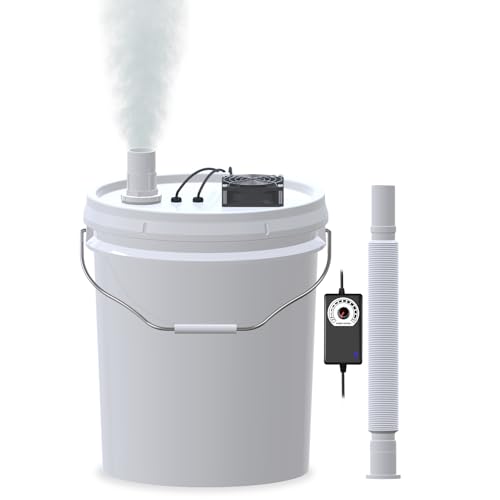
Best for DIY enthusiasts and mid-sized grow setups. This kit turns a 5-gallon bucket into a high-output humidifier with two foggers, an extendable hose, and a water-level sensor. It’s ideal for grow tents, greenhouses, mushroom tents, and terrariums, especially when you have time to assemble a custom humidity system. Note that the bucket itself is not included.
- Choose this if you want a customizable humidity solution with longer runtimes.
- Requires additional bucket and careful assembly for a leak-free fit.
YiMistnnts 6 Head Mist Maker Fogger

Best for versatile installation and moderate spaces. This 6-head fogger can output up to 5000 ml/h with an IP67 waterproof power supply for reliability in humid or dusty environments. It features independent nozzles and over-current/over-heating protections along with auto-sensing water cut-off. Suitable for ponds, rockeries, and office water features. Best for decorative use with strong performance in outdoor or indoor settings.
- Best for mid-sized outdoor or indoor setups needing robust misting.
- May be more complex to wire than single-head models.
PULACO Mist Maker Indoor Fountain

Best for simple, safe indoor use and Halloween or decorative scenes. PULACO’s mist maker works with 24 V safety design and is aimed at ponds, rockeries, fish tanks, vases, and birdbaths. It provides dense mist quickly, with a 7.0 ft cable length for flexible placement. It’s straightforward to install but best for smaller water features due to its single-head design.
- Choose if you want an easy, plug-and-play option for indoor decor.
- Avoid for large-area humidification unless used with additional units.
Buying Guide: How To Choose The Right Ultrasonic Fogger For Plants
What scale is your setup? For small terrariums or decorative fountains, single-head or few-head units are typically sufficient. For larger greenhouses or grow tents, multi-head foggers deliver higher output and more even humidity. Consider the following factors:
- Output capacity: Match ml/h or head count to your space size and humidity goals.
- Durability: Look for 304 stainless steel or IP-rated components for outdoor or humid environments.
- Water protection: Short-circuit or water-shortage protections prevent damage to the ceramic discs.
- Power and safety: Ensure compatible voltage and safe operating distances and enclosure requirements.
- Ease of maintenance: Replaceable discs and modular heads reduce downtime.
Practical Tips For Using Ultrasonic Foggers With Plants
- Monitor humidity levels to avoid mold or fungal growth on plants.
- Place foggers where mist remains near plant canopy but avoids direct leaf splash.
- Use water with minimal minerals to reduce mineral buildup on discs.
- Schedule fog cycles to balance evaporation and plant transpiration needs.
FAQ
- What is an ultrasonic fogger for plants?
It is a device that uses ultrasonic vibrations to turn water into a fine mist, increasing humidity around plants and decorative features. - Are foggers safe around plants and people?
Most models operate at low voltage or include safety protections; always follow the manufacturer’s safety guidelines. - Can foggers be used outdoors?
Yes, but choose models with IP-rated housings and durable materials suitable for outdoor conditions. - How many heads should I choose?
Smaller spaces: 1–2 heads; larger areas: 6–12 heads or multi-head kits for even coverage. - Do foggers require special maintenance?
Replaceable atomizing discs and proper cleaning help maintain mist quality and prolong life. - Can foggers affect plant health?
Proper humidity levels support healthy plant growth; excessive mist can promote mold, so monitor environmental conditions.