Finding the right water pump for a sprinkler system depends on your irrigation needs, water source, and power availability. This guide highlights five reliable options that cover common American lawn irrigation scenarios—from shallow wells to transfer and pressurized garden setups. Each product is suited to different home or small-farm environments, including portable setups, fixed installations, and pressure-boosting needs. Use the comparison notes to choose the best pump for your yard and water source.
| Product | Use Case | Best For | Key Benefit |
|---|---|---|---|
| AQUASTRONG 1.5 HP Shallow Well Jet/Centrifugal Pump | Shallow wells, lawn irrigation | Medium yards, DIY sprinkler systems | High flow up to 4250 GPH |
| ECO-WORTHY 33-Series 4.0 GPM Diaphragm Pump | Low-pressure, on-demand irrigation | RV/garden hose setups, small gardens | Smart pressure switch for automatic on/off |
| Red Lion RL-SPRK150 1.5 HP | Well water or shallow lake water | Residential sprinklers, lift systems | Dual voltage option |
| AQUASTRONG 2 HP Shallow Well Jet/Centrifugal Pump | Higher flow irrigation | Medium-large lawns, robust systems | 5200 GPH capacity |
| Aquastrong 115V Shallow Well Garden Pump with Pressure Tank | Automatic water boosting | Home gardens, yard irrigation with tank | Built-in pressure tank and switch |
AQUASTRONG 1.5 HP Shallow Well Jet/Centrifugal Pump

Best for: Homeowners with a shallow well and a medium-sized lawn who need solid flow for sprinkler heads. This pump delivers up to 4250 GPH with a maximum head of 108 feet, using a 2″ suction and 1-1/2″ discharge. Its dual-voltage capability (115/230 V) and reinforced impeller help ensure reliable performance across typical irrigation setups. It is designed for durability with a cast-iron body, which makes it a strong choice for frequent irrigation cycles.
Why chosen: The combination of high flow and robust construction makes this model well-suited for established lawns that require consistent water delivery. It supports common sprinkler configurations without complex wiring changes thanks to its factory 230 V setting and flexible power options.
Limitation: It requires proper priming and compatible piping; ensure your irrigation system can accommodate a 2″ suction and 1-1/2″ discharge to maximize performance.
ECO-WORTHY 33-Series Industrial Water Pressure Pump
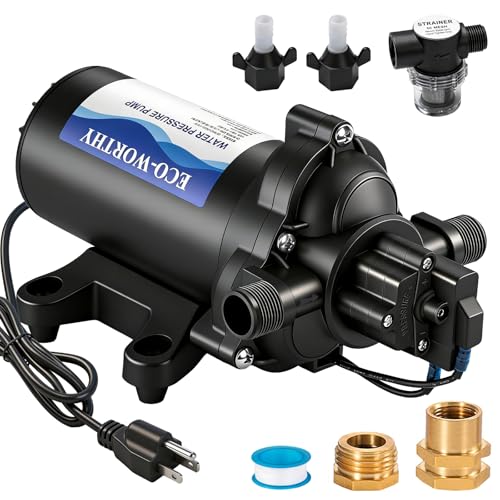
Best for: Users seeking automatic, pressure-driven irrigation without a battery, ideal for RVs, small gardens, or tight spaces. This diaphragm pump activates at 50 PSI and can cycle within a 45-70 PSI range, making it well-suited for on-demand watering needs where quiet, efficient operation matters.
Why chosen: The smart pressure switch and self-priming capability (up to 9.8 ft) help automate irrigation with minimal manual intervention, while a 131 ft lift capacity allows flexible hose routing. It includes thermal protection to guard the motor during heavy use.
Limitation: Not a self-priming unit for deep water wells; prime the system and maintain steady supply from a shallow source or storage tank.
Red Lion RL-SPRK150 1.5 HP Sprinkler Pump

Best for: Homeowners with well or shallow lake water who need a reliable, compact pump that’s easy to install and operate. This unit offers dual voltage operation and a one-time priming process, simplifying setups where a quick, dependable water supply is essential.
Why chosen: The rugged cast-iron housing and glass-filled impeller provide durability in typical yard irrigation conditions, while the ability to switch voltages helps match available power sources without purchasing new equipment.
Caution: Follow the priming instructions precisely; improper priming can impede performance and reduce pump life.
AQUASTRONG 2 HP Shallow Well Jet/Centrifugal Pump

Best for: Larger residential lots or yards requiring higher flow. This 2 HP model delivers up to 5200 GPH and supports a 108 ft max head with 2″ suction and 1-1/2″ discharge, making it suitable for substantial sprinkler systems or multi-zone irrigation.
Why chosen: Higher flow capacity makes this model a better pick for expanding sprinkler layouts or replacing older, undersized pumps. It’s built with a reinforced impeller and diffuser for efficiency and strong water delivery.
Limitation: It runs on single voltage (230 V); verify your electrical setup matches the unit’s power requirements.
Aquastrong 115V Shallow Well Garden Pump with Pressure Tank

Best for: Home gardens and lawn irrigation where automatic pressure boosting is beneficial. This model combines a 1.6 HP motor with a compact 5-gallon pressure tank and a pressure switch, enabling smooth on/off cycling to maintain steady pressure.
Why chosen: The integrated pressure tank and gauge help maintain consistent watering pressure, while automatic overload protection and a waterproof switch enhance safety and reliability in everyday use.
Limitation: Not a self-priming unit; it needs priming and a proper water source before operation.
Buying Guide: Key Considerations For Sprinkler Pump Purchase
- Water source: Determine if your source is a shallow well, a lake, a storage tank, or municipal supply. This affects the necessary suction head and priming needs.
- Flow rate vs. head: Match GPH (gallons per hour) to your sprinkler head types and zoning. Higher GPH helps more heads run simultaneously; head height (ft) determines overall lift required.
- Voltage and power: Check available electrical service. Pumps arrive configured for 115 V or 230 V; ensure circuit capacity and wiring match to avoid tripping or overheating.
- Priming and installation: Some pumps are self-priming; others require pre-filling. Consider piping, valve placement, and whether a quick-priming setup is worth the extra cost.
- Durability and materials: Cast-iron housings and stainless components withstand outdoor conditions; thermoplastics and impellers influence longevity and corrosion resistance.
- Automation and protection: Look for automatic pressure switches and thermal overload protection for safer, hands-off operation.
- Port sizes: Ensure suction and discharge fittings (commonly 2″ suction, 1.5″ discharge) fit your irrigation layout and existing plumbing.
- Noise and installation space: Some units operate quietly; compact designs suit tight spaces and smaller yards.
FAQs
- What size pump do I need for a typical home sprinkler system? – For small to medium lawns, a pump delivering roughly 1000–4000 GPH with adequate head (30–100 ft) usually suffices; larger lawns may require 4000–6000 GPH or more.
- Is a dual-voltage pump necessary? – If your power supply can’t be easily updated to a single voltage, a dual-voltage model provides flexibility to work with existing wiring.
- Do I need a pressure tank with my sprinkler pump? – A pressure tank helps maintain steady pressure, reduces pump cycling, and can improve system longevity in automatic setups.
- What maintenance is typical for these pumps? – Regularly check fittings for leaks, inspect the impeller and diffuser for wear, and ensure electrical connections and switches function properly.
- Can these pumps run off a solar or battery system? – Most listed units are mains-powered (AC) and not designed for direct solar/battery operation without suitable converters and controls.
- How do I know if my pump is primed correctly? – Ensure the suction line is filled with water, remove air pockets, and follow the manufacturer’s priming procedure to avoid air-locks.