Direct answer: The best weather stations for agriculture provide reliable, hyper-local data, easy remote monitoring, and robust sensors that help optimize irrigation, planting, and harvest timing. The top picks below are suited for farmers, greenhouse operators, and homestead growers who need real-time conditions, alerts, and data export for trend analysis.
The following table highlights the five weather stations that balance accuracy, connectivity, and practical features for agricultural use. Consider your farm size, sensor placement options, and whether you need remote alerts or data export when choosing.
| Product | Brand | Best For | Why It Stands Out |
|---|---|---|---|
| Ambient Weather WS-2902 | Ambient Weather | Small to medium farms | Comprehensive sensor array with rain cup; strong Wi-Fi integration; broad smart home compatibility |
| Ambient Weather WS-2000 | Ambient Weather | Home gardens to larger plots | All-in-one sensor suite with TFT display; imperial/metric units; robust data access |
| Tempest Weather Station | WeatherFlow | Precision-focused growers | Hyper-local data with fast updates; well-regarded media presence; wide sensor coverage |
| Sainlogic Smart WiFi Weather Station | sainlogic | Tech-enabled farms | AI-driven forecasts and 24/7 alerts; clear, large display; data export |
| Newentor Weather Station | Newentor | Budget-conscious growers | Large color display; multi-sensor support; adjustable backlight; user-friendly |
Ambient Weather WS-2902 WiFi Smart Weather Station
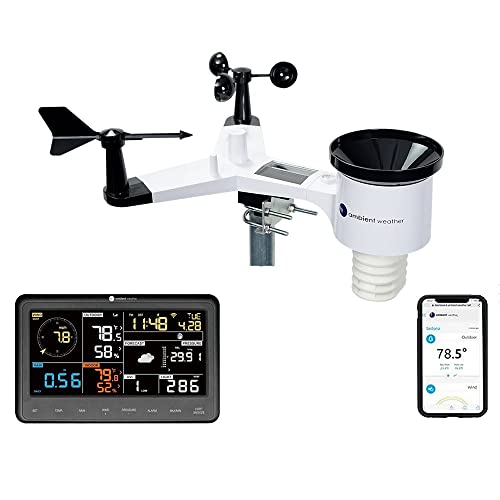
Best for: Farmers needing an all-in-one outdoor sensor array with real-time data and smart home integration. The WS-2902 provides wind speed/direction, temperature, humidity, rainfall, UV, and solar radiation with a color LCD display. Weather alerts and remote access support automation via IFTTT, Google Home, and Alexa are beneficial for farm operations and greenhouse management. This model is well-suited for small to medium plots where centralized data helps guide irrigation and crop protection decisions.
Caution: Data interpretation may require setup of alerts and proper sensor placement to avoid shaded or obstructed readings.
Ambient Weather WS-2000 Smart Weather Station
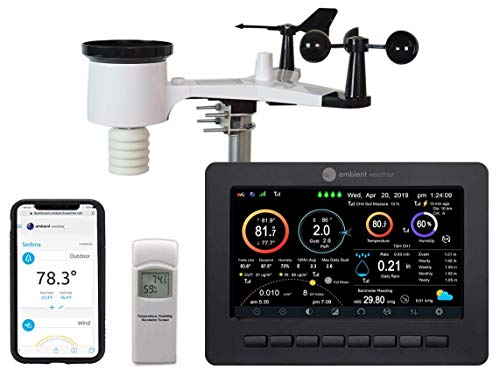
Best for: Gardeners and small farms that want a full-featured, home-based weather hub with a TFT color display and an integrated sensor array. It tracks wind, temperature, humidity, rainfall, UV, and solar radiation, with both imperial and metric units and calibration options. This station is ideal for operators who appreciate a self-contained display and the ability to calibrate measurements for precise irrigation scheduling.
Caution: Setup and calibration may require careful placement to ensure the sensors accurately reflect outdoor conditions.
Tempest Weather Station
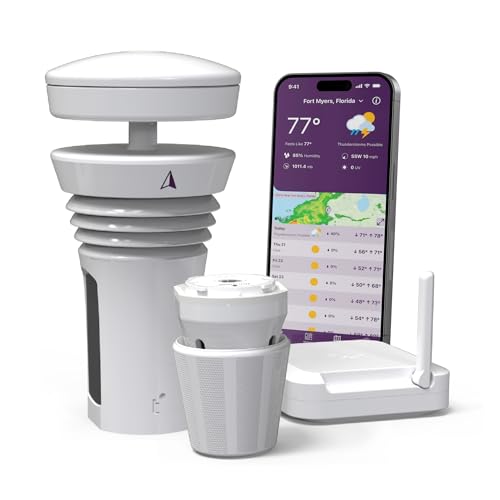
Best for: Growers who rely on precise, hyper-local forecasts and want robust outdoor sensing plus smart app access. The Tempest integrates wind, rain, temperature, humidity, barometric pressure, dew point, UV, lightning, and solar data. The solar-powered sensor transmits up to 1,000+ feet and updates frequently, offering timely data for irrigation and crop protection decisions.
Caution: The range can vary by terrain; line-of-sight and obstructions may affect connectivity in large fields.
Sainlogic Smart WiFi Weather Station

Best for: Tech-savvy farms seeking continuous monitoring with AI-driven forecasts and alerts. The Weather.seed app provides 24/7 monitoring and forecast data, plus customizable alerts for temperature, humidity, and pressure changes. The device emphasizes a high-contrast display for easy on-site reading and supports data export for long-term analysis.
Caution: Requires 2.4 GHz WiFi; some users may need network adjustments to ensure stable connectivity.
Newentor Weather Station

Best for: Budget-conscious growers who still want a comprehensive, color-display station with multiple sensors. The Newentor station supports inside/outside temperature and humidity, time/date, forecast, and up to three remote sensors, making it suitable for small farms or home gardens where extended data history is beneficial.
Caution: Forecasts are approximations and best used alongside local observations; consider supplementary sensors if you need broader coverage.
Buying Guide
What should I consider when selecting a weather station for agriculture?
- Sensor coverage: Look for wind, rain, temperature, humidity, UV, solar radiation, and barometric pressure. More sensors provide better irrigation and crop protection decisions.
- Connectivity: Prioritize WiFi-enabled models for remote monitoring and alerting. Check compatibility with automation systems like IFTTT, Google Home, or Alexa if you plan to automate irrigation or alerts.
- Display and data access: A clear display helps on-site readings; remote dashboards and data export support historical trend analysis and compliance reporting.
- Sensor range and installation: Ensure outdoor sensors can be placed to represent your fields, with minimal shading and obstruction. Consider solar power options for remote locations.
- Data accuracy and calibration: Models offering calibration options and unit choices (imperial/metric) can improve decision quality for irrigation and planting.
- Data storage and export: If you need long-term records, choose devices that export to CSV/Excel or integrate with cloud storage.
- Maintenance and durability: Weatherproof housings, battery life, and ease of sensor replacement matter for farm reliability.
Practical decisions by farm type
- Small home gardens: A compact, display-centric model with alerts (like WS-2000 or Newentor) suffices for basic planning.
- Greenhouses: Models with robust monitoring of temperature, humidity, and dew point, plus remote alerts, are advantageous (Tempest or Sainlogic).
- Outdoor crop fields: Weather stations with long-range sensors and strong connectivity (Tempest or Ambient Weather WS-2902) help optimize irrigation timing and frost protection.
Data use cases
- Irrigation scheduling: Use temperature, humidity, and rainfall data to adjust irrigation runs and avoid overwatering.
- Pest and disease risk: Track humidity and temperature trends to anticipate conditions favorable to fungal diseases or pests.
- Crop forecasting: Combine wind, cloud cover, and radiation data to predict heat stress and harvest windows.
FAQ
- What is the main benefit of a WiFi weather station for agriculture?
It provides real-time data access and remote alerts, enabling timely irrigation and crop protection decisions. - Do these stations support data export?
Some models offer CSV/Excel export or cloud storage for long-term analysis. - Can I use these with smart home devices?
Yes, several models integrate with IFTTT, Google Home, or Alexa for automation. - How important is sensor placement?
Sensor placement directly affects accuracy; avoid shade, heat sources, and obstructions. - Is a more expensive station always better for farms?
Not always. Choose based on sensor coverage, connectivity, and data needs relevant to your operation. - Will these work in remote fields without WiFi?
Some stations rely on WiFi for remote monitoring; consider local displays and satellite options if connectivity is an issue.