Choosing the right weather station helps farmers monitor conditions that affect crop health, irrigation planning, and pest management. This guide highlights five reliable models that balance accuracy, ease of use, and smart features. Each option supports real-time data, trend analysis, and remote access to optimize field decisions across the American farm landscape.
| Product | Brand | Key Benefit |
|---|---|---|
| AcuRite Iris (5-in-1) 01512M | AcuRite | Broad data points for microclimate insights |
| Ambient Weather WS-2902 | Ambient Weather | Wi‑Fi enabled with remote access |
| Newentor Weather Station | Newentor | Multi-sensor flexibility with color display |
| AcuRite 02077M | AcuRite | Color display and simple setup |
| AcuRite Iris 01540M | AcuRite | Wi‑Fi connection to Weather Underground |
AcuRite Iris (5-in-1) Indoor/Outdoor Weather Station
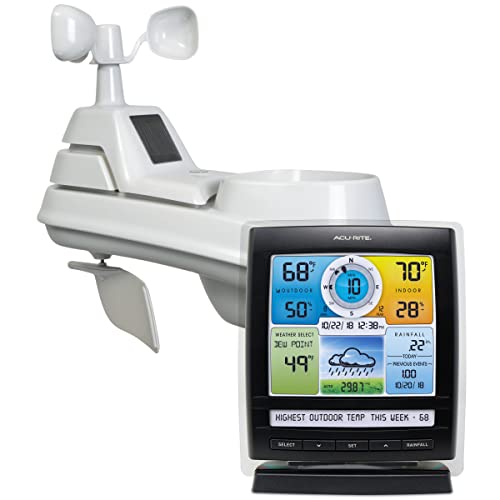
The AcuRite Iris 01512M provides more than 55 data points, allowing farmers to monitor heat index, dew point, pressure trends, rainfall, wind speed and direction, and indoor/outdoor temperature and humidity. Real-time readings arrive wirelessly to the main console, supporting rapid responses to changing field conditions. Setup is straightforward: install batteries, attach the outdoor sensor via the included mounting bracket, and you’re ready to track microclimate conditions across fields and orchards.
With an emphasis on historical data, trend arrows, and comprehensive weather metrics, this model helps farmers identify patterns over days or weeks. It is especially suitable for crops sensitive to humidity and wind shifts, such as fruit trees and leafy greens, where precise environmental monitoring can inform irrigation and disease prevention strategies.
Ambient Weather WS-2902 WiFi Smart Weather Station
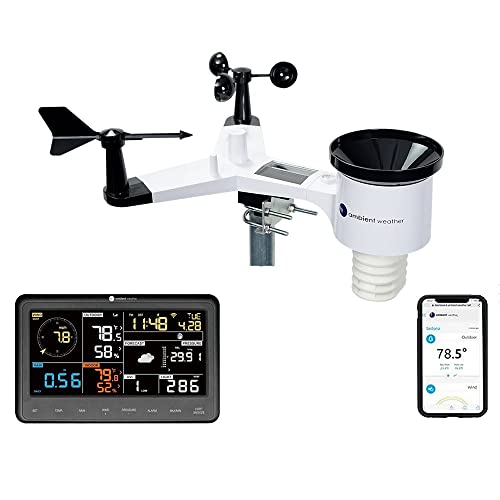
The Ambient Weather WS-2902 delivers a complete weather station experience with an Osprey Sensor Array, a color LCD display, and Wi‑Fi connectivity for remote monitoring. It measures wind speed and direction, temperature, humidity, rainfall, UV index, and solar radiation. Farmers can set alerts and access data remotely, integrating with smart home ecosystems via IFTTT, Google Home, and Alexa. This model shines in precision agriculture setups that rely on timely weather-triggered irrigation and pest management decisions.
Its authentic hyper-local data helps tailor field operations to the actual conditions at the farm’s location, not a broad regional forecast. The combination of real-time metrics and cloud access makes it suitable for multi-field operations, allowing centralized monitoring of several plots or greenhouses from a single dashboard.
Newentor Weather Station Wireless Indoor Outdoor

The Newentor system features a 7.5-inch color LCD, with comprehensive indoor/outdoor temperature and humidity readings, highs and lows, and a 12–24 hour forecast. It supports up to three remote sensors, enabling monitoring across multiple farm zones—like a greenhouse, barn, and field station. The forecast function provides near-term planning for irrigation or harvest prep, while the adjustable backlight improves readability in varying lighting conditions.
Equipped for flexibility, it suits farms seeking a budget-conscious, multi-location solution. The multiple-sensor setup supports expanding the network as farming operations scale, helping to optimize environmental control in diverse spaces such as nurseries and crop beds.*
AcuRite Wireless Home Weather Station 02077M
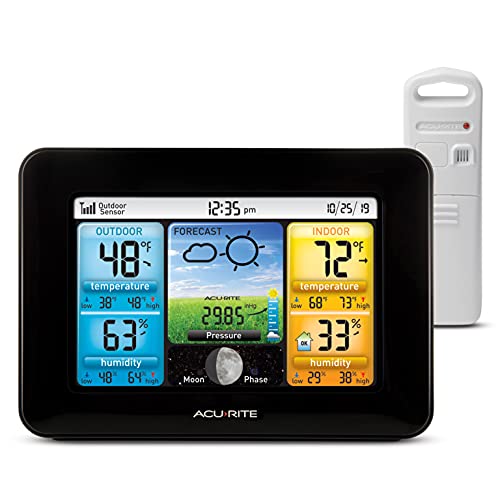
This AcuRite model emphasizes easy setup with a simple outdoor sensor installation and a color display that shows current conditions, forecasts, and barometric pressure trends. It provides real-time weather data and a forecast to help farmers anticipate short-term changes that affect fieldwork timing, watering schedules, and cover crop management. The system’s straightforward pairing makes it a solid option for farms needing reliable, turn-key weather monitoring without a steep learning curve.
AcuRite Iris (5-in-1) Weather Station With Wi-Fi 01540M
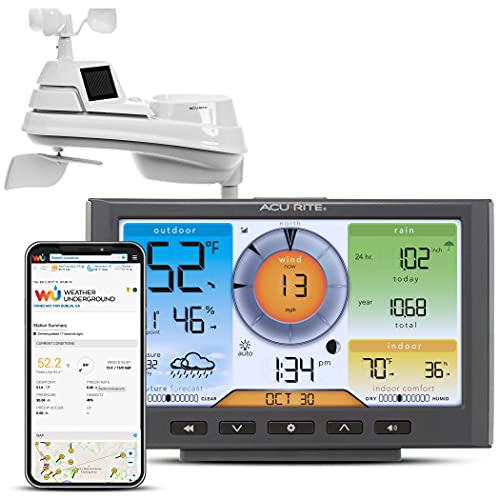
This 01540M Iris model connects to Weather Underground via Wi‑Fi, enabling hyperlocal, remote monitoring from a broad network of stations. It reports indoor/outdoor temperature, humidity, wind speed and direction, barometric pressure, and rainfall. The integration with Weather Underground expands data sharing and historical analysis, aiding farmers who rely on long-term climate trends to schedule irrigation, planting, and protective measures against weather-induced stress.
La Crosse Technology 328-96087-INT

La Crosse Technology’s 328-96087-INT is a professional-grade weather station featuring atomic time and date, wind speed up to 111 mph, wind direction with a compass rose, rainfall totals, and indoor/outdoor temperature and humidity. It includes a high-accuracy Breeze Pro outdoor sensor and provides detailed wind history across multiple time frames. The system supports customizable alerts, making it suitable for farms that require precise wind data for crop protection, irrigation planning, and equipment safety planning.
AcuRite Iris Weather Station With Rain Gauge 01535M
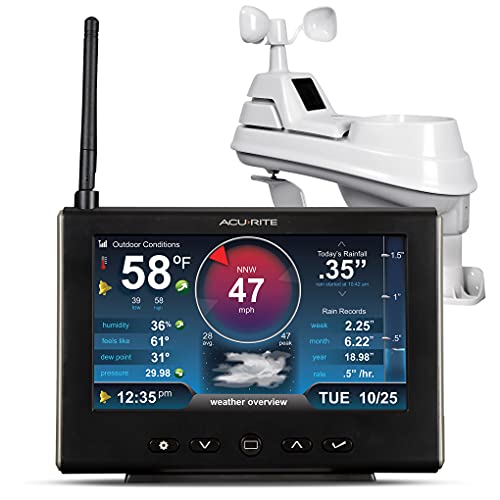
The 01535M Iris model delivers real-time indoor/outdoor readings for temperature, humidity, wind speed and direction, barometric pressure, and rainfall. It includes a large color display with time and date, along with a Weather Underground integration option for remote monitoring. The kit emphasizes straightforward setup and reliable, hyperlocal data streams—useful for farmers who want quick, actionable weather snapshots directly on the display or via connected networks.
Buying Guide
- Data breadth versus simplicity: If you need broad data—temperature, humidity, wind, rainfall, barometric pressure, UV, solar radiation—choose models like the Iris 01512M or the WS-2902. For straightforward, reliable basics, a color display with core metrics may suffice.
- Connectivity and remote access: Wi‑Fi-enabled stations (e.g., WS-2902, 01540M) allow remote monitoring and alerts. If you operate multiple fields or greenhouses, cloud access can streamline management, irrigation scheduling, and disaster readiness.
- Sensor coverage and placement: Look for stations that support multiple outdoor sensors or extendable sensor networks. Farms with several zones benefit from monitoring temperatures, humidity, and wind in different plots.
- Display readability: Large, color displays help quick field checks. Adjustable backlights improve readability at dawn or dusk, which is helpful in early morning tasks.
- Historical data and trends: Systems offering trend arrows, data logging, and long-term history support predictive farming decisions, such as estimating disease risk or frost events.
- Ease of setup and maintenance: Choose models with simple sensor mounting, long battery life, and easy replacements to minimize downtime and maintenance costs.
- Compatibility with farm workflows: Consider whether the device integrates with irrigation controllers, smart home ecosystems, or Weather Underground, depending on your operational needs and data-sharing preferences.
When selecting a weather station for farming, evaluate weather variables critical to crop type, irrigation strategy, and pest management. For orchards and crops sensitive to wind, tailed wind measurements and rainfall data can be decisive. For greenhouse operations, accurate temperature, humidity, and dew point readings support climate control. Finally, consider whether you need local backup data on a display or scalable cloud access for multi-site monitoring.