If you’re dealing with unwanted aquatic weeds in a pond or lake, this guide helps you choose the right weed killer for your water. The selections below are suited for different pond sizes, weed types, and water conditions, from emergent shoreline grasses to submerged vegetation. The top picks favor bold effectiveness, ease of use, and reliable performance across common pond environments. This article targets pond owners, HOA managers, and small lake caretakers seeking practical, field-ready solutions.
Summary table of selected products:
| Product | Best For | Format | Key Benefit |
|---|---|---|---|
| Airmax Shoreline Defense (Quart) | Emergent weeds along shorelines | Liquid concentrate | Kills roots, works in fresh and brackish water |
| Tsunami DQ Aquatic Herbicide (Quart) | Wide range of submerged and emergent weeds | Liquid concentrate | Fast-acting, broad spectrum |
| Airmax Shoreline Defense (Gallon) | Large ponds, ongoing control | Liquid concentrate | Long-lasting root kill |
| Airmax Wipeout Pond Weed Defense (4 oz) | Season-long control for mixed weed types | Granular liquid mix | Systemic floridone-based control |
| Airmax Ultra Pondweed Defense (Quart) | Submerged and floating weeds | Liquid concentrate | Broad spectrum, fast deployment |
Airmax Shoreline Defense Emergent Weed Control (Quart)

What it is best for: Emergent shoreline weeds such as cattails and phragmites in fresh or brackish water. This product is designed to reach root systems, helping prevent regrowth after treatment.
Why selected: It targets roots and provides long-term control, making it a solid choice for shorelines, docks, and beaches with persistent emergent vegetation. It’s suitable for smaller ponds and coastal-adjacent water bodies where emergent species dominate.
Who it’s best for: Pond owners with visible shoreline grasses and reeds needing durable root-level suppression.
Important note: For best results, use with a surfactant as directed to improve foliar absorption and root kill for long-term effects.
Tsunami DQ Aquatic Herbicide (Quart) By Crystal Blue

What it is best for: A broad range aquatic plant and algae control across ponds and lakes, including duckweed, watermeal, curly leaf pondweed, and pondweed species.
Why selected: This diquat-based herbicide emphasizes fast action and wide-spectrum effectiveness, making it suitable for ponds with multiple weed types that require rapid thinning.
Who it’s best for: Water bodies with mixed weed communities needing a robust, quick-response treatment.
Important note: Availability can vary by state; confirm local regulations before purchase if applying on regulated water bodies.
Airmax Shoreline Defense Emergent Weed Control (Gallon)

What it is best for: Large ponds needing ongoing emergent weed control along shorelines and edges.
Why selected: This gallon-size option supports bigger applications and prolonged management, particularly where shorelines are heavily infested with emergent weeds.
Who it’s best for: Commercial or HOA ponds, or residential ponds with substantial shoreline vegetation that requires extended treatment planning.
Important note: Consistent application improves long-term control; follow label directions for mixing ratios and timing to avoid environmental stress on aquatic life.
Airmax Wipeout Pond Weed Defense (4 oz)
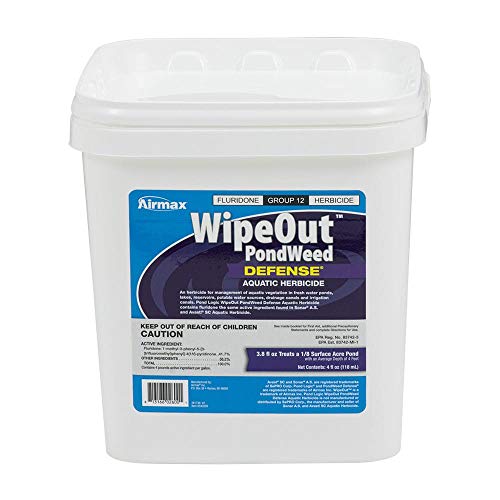
What it is best for: Mixed floating and submerged weeds, including duckweed, water lilies, hydrilla, and milfoils.
Why selected: Its systemic floridone-based approach provides multi-season control with straightforward application—ideal for busy pond owners and larger outdoor spaces.
Who it’s best for: HOAs, commercial facilities, or homeowners seeking a simple, season-long solution without frequent reapplication.
Important note: This product is a granular/solution blend designed for easy distribution; avoid oversaturation near inflows to prevent unintended effects on non-target species.
Airmax Ultra Pondweed Defense (Quart)

What it is best for: Submerged and floating pond weeds, including watermilfoil, hydrilla, and naiad species.
Why selected: Broad-spectrum coverage makes this a versatile option for ponds with diverse weed populations and the need for rapid, broad control.
Who it’s best for: Larger water bodies needing reliable management across multiple weed types with a single product.
Important note: Use with surfactant if recommended and ensure uniform coverage for consistent results across the pond surface.
Buying Guide
What to consider when choosing a pond weed killer
- Weed type: Determine whether your priority is emergent shoreline vegetation, submerged weeds, or floating algae.
- Water conditions: Freshwater vs. brackish water; some products work better in one environment than another.
- Treatment method: Liquid concentrates offer fast action and deep root kill, while granular and slow-release formulas provide ongoing control with simpler application.
- Scale: Size of the pond or lake affects how much product you’ll need and whether a gallon or quart size is more economical.
- Safety and compatibility: Check for fish safety, reservoir life, and local regulations; confirm compatibility with your aquatic life and water usage plans.
- Application plan: Some products require surfactants or specific mixing; align with your equipment (tank sprayer, spreader) and maintenance schedule.
Application tips for best results
- Apply during weed growth peaks for quicker uptake and effectiveness.
- Follow label directions precisely for mixing ratios and water conditions.
- Use surfactants as recommended to improve leaf absorption and root contact.
- Stagger applications if treating multiple weed types to avoid stressing the ecosystem.
FAQ
- What is the fastest way to clear a pond of weeds? Use a fast-acting liquid herbicide designed for your weed types and apply under calm weather with proper surfactants as directed.
- Are pond weed killers safe for fish? Most are designed to minimize impact on fish when used per label; always follow safety guidelines and local regulations.
- Can I treat my pond myself or should I hire a professional? For many residential ponds, DIY treatment with the correct product and clear instructions is feasible; larger or regulated water bodies may require professional application.
- Do these products kill roots or just surface weeds? Some products are formulated to kill through the plant system to prevent regrowth, including root kill in emergent species.
- How often should I re-treat the pond? Re-treatment depends on weed re-growth and product type; follow label guidance and monitor weed regrowth to determine timing.
- Can I use more than one product at a time? Generally not recommended unless specified by the label or a professional; mixing can cause unintended chemical interactions.